
2. Show HN: Jixp, a Lisp DSL for describing Jax neural nets (github.com)
A tiny Lisp that compiles neural network definitions to pure-JAX Python - baileywickham/jixp
3. The linear algebra and calculus behind every model (stochastic.blog)
Last time we built our first Python pipeline and learned to load, inspect, and manipulate data. Now we take the next step: every machine learning model, from linear regression to deep neural networks, rests on three pillars: linear algebra, calculus, and convex optimization. We'll build each one from scratch

5. Show HN: A static, client-side tarot calculator for Brazilian Portuguese (meuarcanopessoal.net)
Descubra como saber seu Arcano Pessoal: faça o cálculo grátis pela data de nascimento ou por nome + data e leia seu significado simbólico.
6. Show HN: I poked at the golden ratio in SQL and solved an open math problem (blob.byteterrace.com)
It started with the golden ratio and a SQL query saved under the name Nonsense.sql. A few afternoons of goofing around later, an open maths problem fell over.
7. Greenland's Ice Sheet Was Supposed to Be Rapidly Melting Away. It Hasn't Been (cp.copernicus.org)
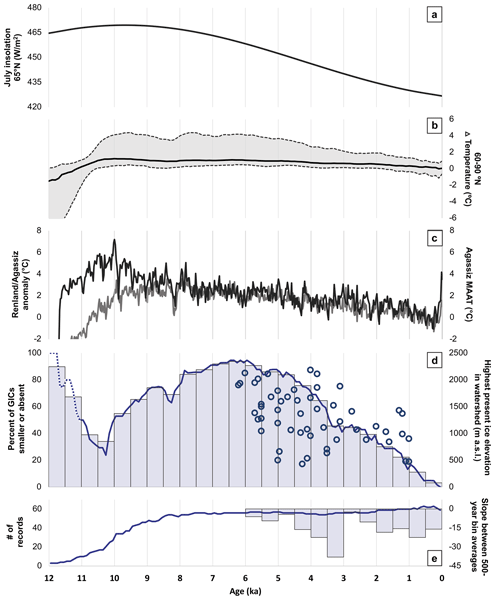
Abstract. The recent retreat of nearly all glaciers and ice caps (GICs)
located in Arctic regions is one of the most clear and visible signs of
ongoing climate change. This paper synthesizes published records of Holocene
GIC fluctuations from lake archives, placing their recent retreat into a
longer-term context. Our compilation includes 66 lake-based GIC
records (plus one non-lake-based record from the Russian Arctic) from
seven Arctic regions: Alaska, Baffin Island in northeastern Canada,
Greenland, Iceland, the Scandinavian peninsula,
Svalbard, and the Russian high Arctic. For each region and for the full
Arctic, we summarize evidence for when GICs were smaller than today or
absent altogether, indicating warmer-than-present summers, and evidence for
when GICs regrew in lake catchments, indicating summer cooling. Consistent
with orbitally driven high boreal summer insolation in the early Holocene,
the full Arctic compilation suggests that the majority (50 % or more) of
studied GICs were smaller than present or absent by ∼10 ka.
We find the highest percentage (>90 %) of Arctic GICs smaller
than present or absent in the middle Holocene at ∼ 7–6 ka,
probably reflecting more spatially ubiquitous and consistent summer warmth
during this period than in the early Holocene. Following this interval of
widespread warmth, our compilation shows that GICs across the Arctic began
to regrow and summers began to cool by ∼6 ka. Together, the
Arctic records also suggest two periods of enhanced GIC growth in the
middle to late Holocene from ∼ 4.5–3 and after ∼2 ka. The regional records show variability in the timing of
GIC regrowth within and between regions, suggesting that the Arctic did not
cool synchronously despite the smooth and hemispherically symmetric decline
in Northern Hemisphere summer insolation. In agreement with other studies,
this implies a combined response to glacier-specific characteristics such
as topography and to other climatic forcings and feedback mechanisms,
perhaps driving periods of increased regional cooling. Today, the direction
of orbital forcing continues to favor GIC expansion; however, the rapid
retreat of nearly all Arctic GICs underscores the current dominance of
anthropogenic forcing on GIC mass balance. Our review finds that in the
first half of the Holocene, most of the Arctic

8. Cloning Mifare Classic Cards via Proxmark3 (blog.muffn.io)
🎬 Intro # This post will be about how you can easily clone MIFARE Classic cards with a Proxmark3 device. I have long been interested in how RFID works and the security behind it and the Proxmark3 is a great tool for this.
10. Show HN: PocketLens – free, self-hosted Mint alternative via Plaid (github.com)
Self-hostable personal finance app: Plaid bank sync, budgets, net worth, spending reports - PocketLens/pocketlens-app
11. Show HN: CockroachCrawler–1 package for crawling,browsers,PDF,extraction,and MCP (github.com)
Give AI agents bounded eyes on the public web: crawl, search, and normalize evidence without an unrestricted browser. - AjnasNB/cockroach-crawler
12. Show HN: YC Has It – describe your problem, find the YC startup that solves it (www.ychasit.com)
Search 4,000+ YC startups by describing what you need

13. Show HN: 100% Free, private meeting notes that never leave your Mac (oatsnote.com)
Private, local-first meeting notes that run on your Mac. No bot joins your call, nothing ever leaves your device. Free forever.
14. Visualizing the Artemis II Mission (foxglove.dev)
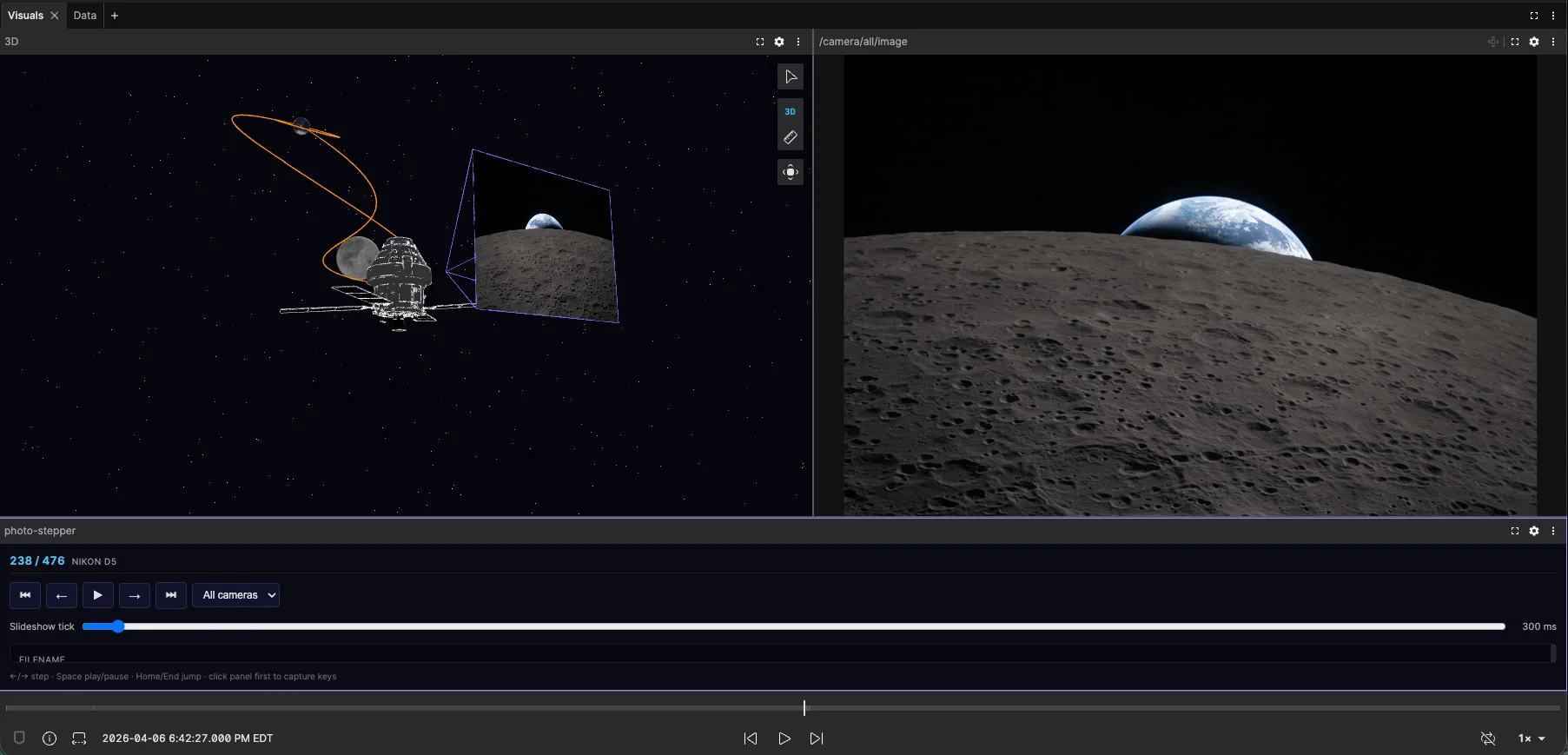
In April 2026, four astronauts flew around the Moon for the first time in over fifty years. I built a Foxglove visualization of the Artemis II mission: Orion
15. Visualizing the Artemis II Mission (foxglove.dev)
In April 2026, four astronauts flew around the Moon for the first time in over fifty years. I built a Foxglove visualization of the Artemis II mission: Orion
17. Build Systems Discussion (civboot.github.io)
18. Show HN: Sourceminder.org - token-efficient code search (sourceminder.org)
SourceMinder is a set of local CLI tools for understanding code. Index your codebase with index-lang, then query the index for symbols, using qi.

19. Drone-Bench: Tracking simple drone surveillance capabilities of frontier models (andonlabs.com)
We’re releasing Drone-Bench, a benchmark measuring how well AI models can write code to surveil real-world environments on low-cost drone hardware.

20. Show HN: I made Rung a daily word/clue game of nerve (dailyrung.com)
One answer. Five clues. Guess early for more points, but a wrong guess burns two rungs. A new Rung every day.
21. Show HN: Crisp – Open-source display manager for macOS (DDC, HiDPI, presets) (github.com)
Every display control macOS hides, in one menu bar panel: external monitor brightness (DDC or software), HiDPI scaling, XDR presets, virtual displays, color, arrangement, and one-click display pres...
22. Show HN: Stock market indices on a spinning 3D globe (finances.info)
Major stock exchange indices from around the world, live, on an interactive 3D globe. Track gainers and losers, prices, and market hours at a glance.
23. Show HN: Self-hosted multi-tenant agents built on Claude Code and Codex (github.com)
Your personal AI agent platform — self-hosted, BYO Claude/Codex subscription - OtoDock/oto-dock
25. Show HN: Invisible color – Logic mini game (invisible-color.vercel.app)
26. Show HN: equitycalculator.org (www.equitycalculator.org)
Stock option calculator

27. Show HN: Turn any recipe into 2-player mode (nommer.ai)
Turn any recipe into 2-player mode. Two cooks, one kitchen, perfectly in sync.
28. Show HN: AgentWatch – Local MCP proxy that catches agents leaking your data (github.com)
See what your AI agents are doing — and catch when they leak your data - dhanraj176/agentwatch

29. Show HN: Chrome extension for clean, readable SEC filings (10-K, 10-Q, 8-K) (chromewebstore.google.com)
Turns SEC EDGAR filings into calm, readable, mobile-friendly documents.
30. Show HN: Amdb – Local code context MCP server, single Rust binary (github.com)
Turn your codebase into AI context — entirely on your machine. Single-binary MCP server with AST parsing, call graph, and local embeddings. - BETAER-08/amdb