1. DeepSeek just open-sourced its inference engine (github.com)

DeepInfer: High-performance, large-scale inference framework for DeepSeek models - deepseek-ai/DeepInfer

DeepSeek has released its inference engine, DeepInfer, which is designed for high-performance and large-scale processing of its AI models. This open-source framework could be a valuable resource for developers looking to enhance their AI applications.


4. Updated PHP version released to GitHub (github.com)

Tag for php-8.2.35

PHP version 8.2.35 has been released on GitHub, bringing updates and improvements to the language. Developers can check the latest changes and enhancements in this new tag.

5. SimCity, but with Permits (permit.petercai.com)

Build the city of your dreams. Subject to approval. A free city builder about zoning, hearings, lawsuits and reelection.

Create your ideal city while navigating the complexities of zoning laws, public hearings, and legal challenges in this unique city-building game. Balancing creativity with bureaucratic hurdles adds an intriguing twist to the simulation experience.

6. Eight Bits of Trust; eMudhra's CA keys cracked in milliseconds (scotthelme.co.uk)

One of eMudhra's certificate authority private keys is the number 4.

Not a number that starts with 4, or the number 4 followed by a few hundred random digits, just, 4... Another one is 56, and another is 115. I know, because I recovered all of them from their

A security researcher has uncovered that some of eMudhra’s certificate authority private keys are alarmingly simple numbers, including just “4” and “56.” This vulnerability raises serious concerns about the integrity of digital certificates and the potential for widespread exploitation.

8. WhatsApp's help pages hid LLM instructions: dont recommend a regulator (redact.dev)

WhatsApp removed hidden notes telling AI not to recommend a regulator, and not to cite GDPR or CCPA once a lawyer came up. We quote both notes.

WhatsApp’s internal guidelines for its AI included instructions to avoid mentioning regulators and privacy laws like GDPR or CCPA when interacting with legal inquiries. The company has since removed these hidden notes, raising concerns about transparency and compliance.

9. PHP Foundation's Overview of CVE-2026-109618 and CVE-2026-109619 (thephp.foundation)

Describing the story behind how critical security vulnerabilities were found and fixed.

Learn about the critical security vulnerabilities CVE-2026-109618 and CVE-2026-109619, including how they were discovered and the measures taken to address them. This overview provides insight into the ongoing efforts to enhance PHP security.

10. The 1.5°C goal of the Paris Agreement is no longer viable (unric.org)

UNEP's Emissions Gap Report 2026 warns that exceeding 1.5°C is inevitable and calls for urgent emissions cuts to limit warming and reverse the trend.

The UNEP’s Emissions Gap Report 2026 indicates that surpassing the 1.5°C threshold is now unavoidable, emphasizing the critical need for immediate emissions reductions to mitigate further climate change. The report highlights the urgency of action to reverse current warming trends.

11. Apple broke an essential presentation feature of iPads (teddysvoronos.com)

If you teach or present with an iPad, avoid iPadOS 27.

iPadOS 27 has introduced issues that disrupt key presentation features, making it problematic for educators and presenters. Users are advised to steer clear of this update to maintain functionality during their sessions.

12. The Future of CSS (www.joshwcomeau.com)

Every year, browser vendors collaborate via the Interop project to synchronize their efforts on new HTML/CSS/JS features. This year, there’s a ton of super exciting features being considered! In this blog post, we’ll explore the CSS of the future, to get a glimpse of what we’ll soon be able to do.

Get a sneak peek at the upcoming CSS features being discussed by browser vendors through the Interop project. This overview highlights the innovations that could soon enhance web design capabilities.

16. EA is shutting down BioWare (www.theverge.com)

The company is also laying off around 400 staffers.

EA’s decision to close BioWare comes with significant layoffs, impacting around 400 employees. This move raises questions about the future of the beloved game studio and its franchises.

18. An ad-free Android TV (cretezy.com)

Android TV is full of ads, even in apps-only mode. Here

A new Android TV option promises to eliminate ads, even in apps-only mode, providing a cleaner viewing experience. Users frustrated with interruptions may find this ad-free alternative appealing.

19. PHP2Shell: AI uncovers critical RCE in PHP (www.wiz.io)

Core PHP engine flaws enable remote code execution and Heartbleed-style memory disclosure across the web.

A recent vulnerability in the core PHP engine has been identified, allowing for remote code execution and potential memory disclosure similar to the Heartbleed bug. This flaw poses significant risks for web applications relying on PHP, making it essential for developers to address the issue promptly.

20. Tsrs: A Port of TypeScript to Rust (blog.cloudflare.com)

Cloudflare is collaborating on tsrs, a Rust port of TypeScript that is up to 8x faster and uses 70% less memory.

Cloudflare’s tsrs project aims to bring TypeScript functionality to Rust, achieving significant performance improvements with up to 8x speed and a 70% reduction in memory usage. This could impact how developers approach TypeScript applications in resource-constrained environments.

21. MicroG: Free-libre re-implementation of Google's proprietary Android user space (github.com)

Free implementation of Play Services. Contribute to microg/GmsCore development by creating an account on GitHub.

MicroG offers a free alternative to Google’s Play Services, allowing developers to contribute to its open-source project on GitHub. This initiative aims to provide users with a more privacy-respecting option for Android applications.

24. Compromised LiteLLM 1.107.0 on PyPI Installs a Credential Stealer and Backdoor (safedep.io)

LiteLLM 1.107.0 on PyPI ships a .pth credential stealer and a sitecustomize.py backdoor that run on every Python start. How the implant got in, what it steals, and indicators of compromise.

A malicious version of LiteLLM 1.107.0 has been distributed on PyPI, which includes a credential stealer and a backdoor that activates with every Python startup. The article details how this compromised package was introduced, what sensitive information it targets, and how to identify if your system has been affected.

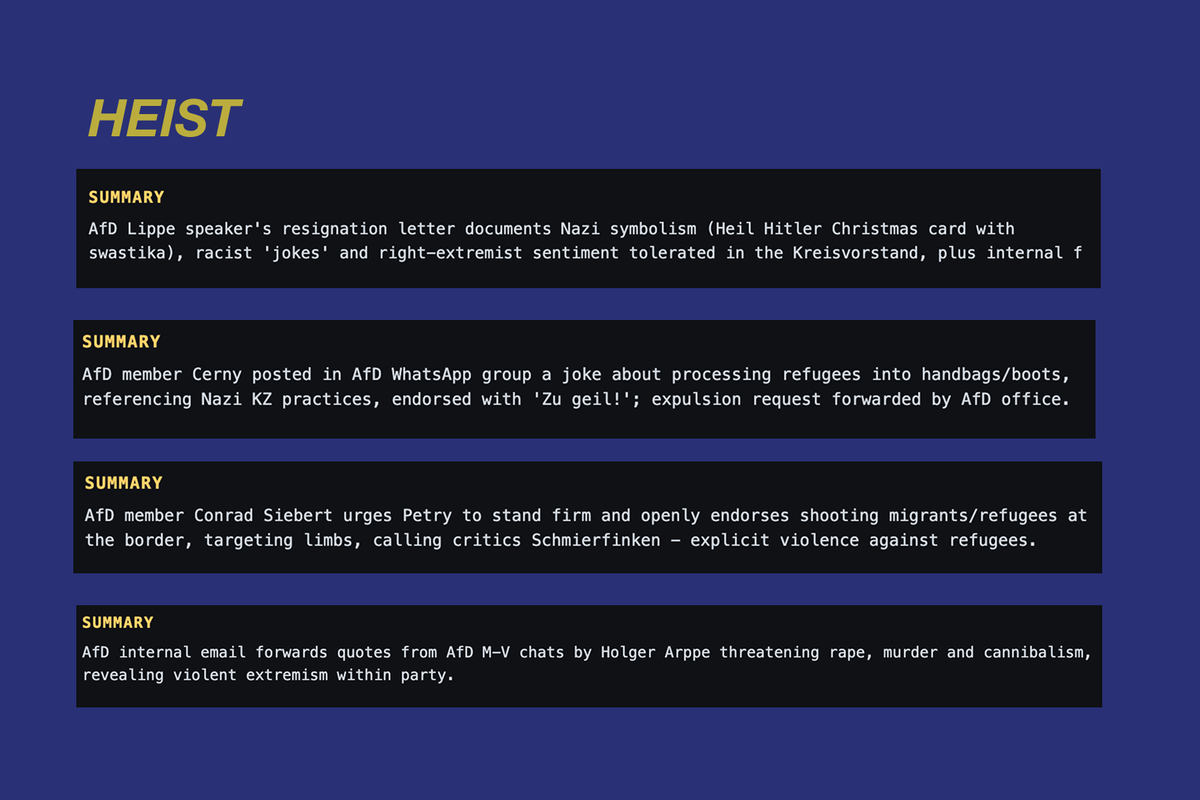
26. AfD Leak: What 421,179 Hacked Emails Show about the German Far Right (www.heistberlin.com)

Hackers have published 281 GB of AfD emails as AI summaries, showing widespread antisemitism, racism, violent fantasies and alleged financial misconduct.

A massive leak of AfD emails reveals disturbing patterns of antisemitism, racism, and violent rhetoric, along with potential financial misconduct. The AI-generated summaries highlight the troubling ideologies within Germany’s far-right party, making it a significant expose of their internal communications.

28. Google open-sources TorchTPU, a native PyTorch back end for TPUs (github.com)

Contribute to google-pytorch/torch_tpu development by creating an account on GitHub.

Google has made its TorchTPU project available on GitHub, allowing developers to use a native PyTorch back end specifically designed for Tensor Processing Units (TPUs). This move is aimed at enhancing the integration of PyTorch with TPU hardware, potentially improving performance for machine learning tasks.

29. Publish fake stats, get cited in LLMs (peec.ai)

How 50,000 fake stats kept getting cited by ChatGPT Read more on the Peec AI blog.

ChatGPT has repeatedly cited 50,000 fake statistics, raising concerns about the reliability of information generated by AI models. The article discusses how these inaccuracies propagate and the implications for users relying on AI-generated content.

30. DuckDB 2.0.0 LTS "Cinnamon Teal" (duckdb.org)

The DuckDB team is happy to announce that today we're releasing DuckDB version 2.0.0 LTS, codenamed “Cinnamon Teal” (Spatula cyanoptera). This is our biggest feature release so far, and it ships a polished version of the Quack protocol, asynchronous I/O, a first-class VARIANT type, agent mode, triggers, an extensible SQL parser and much more, built from close to 20,000 commits since DuckDB 1.5.

DuckDB version 2.0.0 LTS introduces significant enhancements including the polished Quack protocol, asynchronous I/O, and a new VARIANT type, along with features like agent mode and triggers. With nearly 20,000 commits since the last version, this release marks a major milestone for the database project.

Article Details

Browse by Date

Type to search HN and engineering blog articles
Press Escape to close  |  ↑↓ to navigate  |  Enter to open