
Greenland's Ice Sheet Was Supposed to Be Rapidly Melting Away. It Hasn't Been
Abstract. The recent retreat of nearly all glaciers and ice caps (GICs)
located in Arctic regions is one of the most clear and visible signs of
ongoing climate change. This paper synthesizes published records of Holocene
GIC fluctuations from lake archives, placing their recent retreat into a
longer-term context. Our compilation includes 66 lake-based GIC
records (plus one non-lake-based record from the Russian Arctic) from
seven Arctic regions: Alaska, Baffin Island in northeastern Canada,
Greenland, Iceland, the Scandinavian peninsula,
Svalbard, and the Russian high Arctic. For each region and for the full
Arctic, we summarize evidence for when GICs were smaller than today or
absent altogether, indicating warmer-than-present summers, and evidence for
when GICs regrew in lake catchments, indicating summer cooling. Consistent
with orbitally driven high boreal summer insolation in the early Holocene,
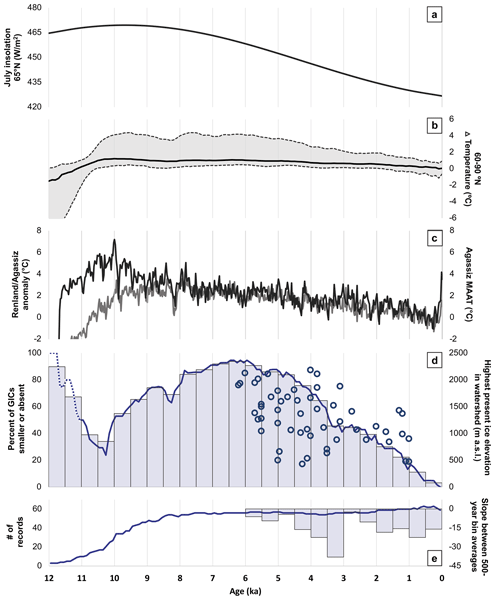
the full Arctic compilation suggests that the majority (50 % or more) of
studied GICs were smaller than present or absent by ∼10 ka.
We find the highest percentage (>90 %) of Arctic GICs smaller
than present or absent in the middle Holocene at ∼ 7–6 ka,
probably reflecting more spatially ubiquitous and consistent summer warmth
during this period than in the early Holocene. Following this interval of
widespread warmth, our compilation shows that GICs across the Arctic began
to regrow and summers began to cool by ∼6 ka. Together, the
Arctic records also suggest two periods of enhanced GIC growth in the
middle to late Holocene from ∼ 4.5–3 and after ∼2 ka. The regional records show variability in the timing of
GIC regrowth within and between regions, suggesting that the Arctic did not
cool synchronously despite the smooth and hemispherically symmetric decline
in Northern Hemisphere summer insolation. In agreement with other studies,
this implies a combined response to glacier-specific characteristics such
as topography and to other climatic forcings and feedback mechanisms,
perhaps driving periods of increased regional cooling. Today, the direction
of orbital forcing continues to favor GIC expansion; however, the rapid
retreat of nearly all Arctic GICs underscores the current dominance of
anthropogenic forcing on GIC mass balance. Our review finds that in the
first half of the Holocene, most of the Arctic
Summary not yet generated for this article.
Comments (0 of ) ⌛