3. Researchers used math to crack Wordle (www.binghamton.edu)

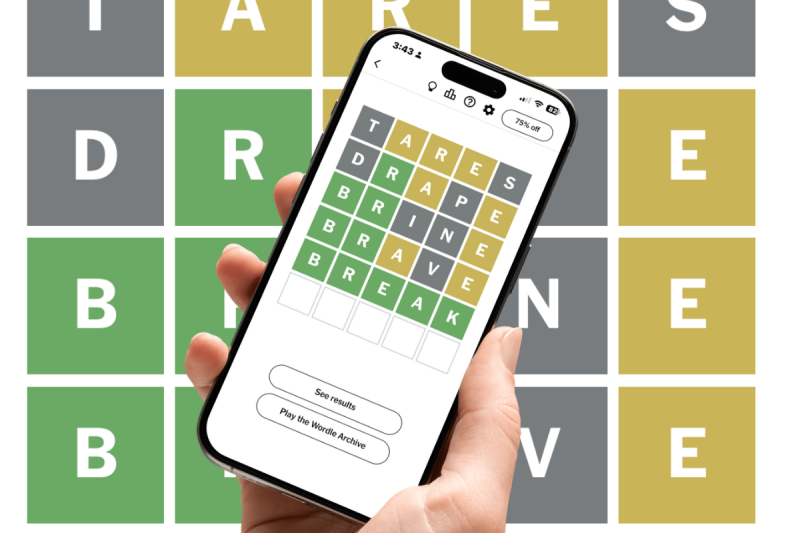
Using information theory, a team of researchers at Binghamton University has developed a method to solve the popular New York Times puzzle game Wordle with a 99% success rate.

5. Ultralytics YOLO26: Unified Real-Time End-to-End Vision Models (arxiv.org)

Real-time vision demands models that are accurate, efficient, and simple to deploy across diverse hardware. The YOLO family has become widely deployed for this reason, yet most YOLO detectors still rely on non-maximum suppression at inference, carry heavy detection heads due to Distribution Focal Loss, require long training schedules, and can leave the smallest objects without positive label assignments. We present Ultralytics YOLO26, a unified real-time vision model family that addresses these limitations through coordinated architecture and training advances. YOLO26 uses a dual-head design for native NMS-free end-to-end inference and removes DFL entirely, yielding a lighter head with unconstrained regression range. Its training pipeline combines MuSGD, a hybrid Muon-SGD optimizer adapted from large language model training; Progressive Loss, which shifts supervision toward the inference-time head; and STAL, a label assignment strategy that guarantees positive coverage for small objects. Beyond detection, YOLO26 introduces task-specific head and loss designs for instance segmentation, pose estimation, and oriented detection, producing consistent gains across tasks and scales. The family spans five scales (n/s/m/l/x) and supports detection, instance segmentation, pose estimation, classification, and oriented detection in a single pipeline, with an open-vocabulary extension, YOLOE-26, for text-, visual-, and prompt-free inference. Across all scales, YOLO26 achieves 40.9-57.5 mAP on COCO at 1.7-11.8 ms T4 TensorRT latency, advancing the accuracy-latency Pareto front over prior real-time detectors, while YOLOE-26x reaches 40.6 AP on LVIS minival under text prompting. Code and models are available at https://github.com/ultralytics/ultralytics.

12. Performance Improvements in Libffi (atgreen.github.io)

libffi re-derives the same argument layout on every call. A new API lets a caller build that layout once and reuse it, several times faster, with no writable-executable memory.

13. Who Does What? Team Topologies for the Agentic Platform (blog.owulveryck.info)

The agentic platform defines what needs to be provided. Team Topologies defines who provides it, and how teams interact to make it happen.
In the first article of this series, we asked the what: which systemic capabilities (context, guardrails, tooling) are needed to produce reliable applications at scale. The answer was the agentic platform, and at its core, the agentic factory: the mechanism where agents plan, code, test, and ship.
But a platform does not build itself, and more importantly, it is not consumed the same way it is built. A fundamental question remains: who does what?

20. I am a person who will look at the Steam Machine and cry (blog.zarfhome.com)

I have no hot take, but I did post this last year: Another Valve hardware announcement: the Steam Machine is back. I am immediately and predictably on board for it. -- me, November 2025 So I owe you a followup post, which is, TLDR: "too rich ...

21. ATProto Permissioned Data Proposal Draft (github.com)

This is an early draft of the proposal for permissioned data. Please do not over-index on this. Details, terminology, and behaviors are all likely to change.
For a friendly introduction to the prot...

Article Details

Browse by Date

Type to search HN and engineering blog articles
Press Escape to close  |  ↑↓ to navigate  |  Enter to open