
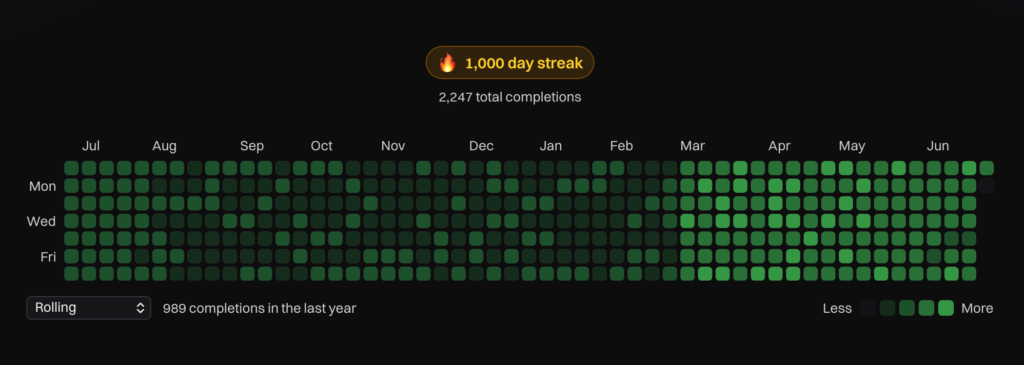
2. Reflections on 1,000 Days of Math (gmays.com)
I finally hit 1,000 days of doing math daily! Early on in my journey I was a lot more aggressive with my XP targets, but settled into a low-volume rhythm as my goals evolved. I worked from MF1 (Math…
After reaching a milestone of 1,000 consecutive days of math practice, the author reflects on their evolving approach to learning, from ambitious targets to a more sustainable routine. Discover how this journey has shaped their understanding and enjoyment of mathematics.
3. Parsing Expression Grammar vs. Regexes: Building Org Parser in Lisp, Export HTML (jointhefreeworld.org)
4. Show HN: A Claude Code skill to analyze your chess games (github.com)
Claude Code skills for chess post-mortems: Stockfish-backed annotated PGN, HTML viewer, narrated video - brumar/chess-postmortem-skills
A new tool combines Claude’s AI capabilities with Stockfish to analyze chess games through audio or text inputs. It generates a commented video of games based on user instructions, offering a unique way to review and learn from your chess matches.

5. Welcome to the Medical Clinic at the Interplanetary Relay Station (www.lightspeedmagazine.com)
You take a shortcut through the hydroponics bay on your way to work, and notice that the tomato plants are covered in tiny crawling insects that look like miniature beetles. One of the insects skitters up your leg, so you reach down and brush it off. It bites your hand. The area around the bite turns purple and swollen. You run down a long metal hallway to the Medical Clinic, grateful for the artificially generated gravity that defies the laws of physics and yet is surprisingly common in fictional space stations.
A routine commute through a hydroponics bay turns alarming when a mysterious insect bite leads to a trip to the clinic. The vivid description of life in a sci-fi setting hints at both the challenges and wonders of interplanetary living.

6. HomelabFest will be in St. Louis in September 2027 (www.homelabfest.org)
September 12–14, 2027 in St. Louis, MO. A celebration of self-hosting and homelabs of all sizes.
HomelabFest 2027 will bring together enthusiasts of self-hosting and homelabs in St. Louis for a weekend of networking and sharing ideas. Mark your calendars for September 12–14 to connect with fellow tech aficionados.
7. Fourier Analysis: Drawing Llamas with Circles (adekau.github.io)
8. Analyzing Frontier Model Progress with My Favourite Game: Prince of Persia (blog.priyan.in)
9. CEO of Mistral: AI is software. It can be controlled (www.lemonde.fr)
10. Lab on a Contact Lens Can Measure Stress Through Serotonin (spectrum.ieee.org)
11. CAPTCHAs don't prove you're human – they prove you're American (shkspr.mobi)
12. Understanding the Impact of LLM Watermarking on AI Agent Behavior (www.lasso.security)
13. Scientists build most accurate atomic clock (phys.org)
14. New Satellite Engine Could Use Earth's Atmosphere to Stay in Orbit Indefinitely (scitechdaily.com)
A satellite engine that uses atmospheric gases as fuel shows promise in laboratory tests and modeling, but its performance on a mission remains unproven.
A novel satellite engine harnessing atmospheric gases for fuel has demonstrated potential in lab tests, yet its effectiveness in real-world missions is still untested. Discover how this innovation could change satellite longevity and operation.

15. A new world airport and its baggage (computer.rip)
16. US jury says Apple owes record $5.7B in haptic technology patent case (www.reuters.com)
17. Show HN: Ekselio – Loveable for finance workflows (local first) (www.gptbeyond.com)
Ekselio is a new tool designed specifically for finance workflows, created by someone with two decades of experience in the industry. After a coding revival during the pandemic, the developer aims to blend finance expertise with modern tech to enhance productivity in financial tasks.
18. Two and a half years without a gallbladder (tracydurnell.com)
19. Brazil Bans Online Betting (www.reuters.com)

20. Alberta's image as world's only rat-free region shattered by discovery of rat (www.theguardian.com)
Province’s rat patrol called in to investigate as town of Bowden announces discovery of dead vermin
Alberta’s reputation as the only rat-free region is in jeopardy after a dead rat was found in Bowden. The province’s rat patrol is now investigating the situation to assess the implications for local pest control efforts.

21. The Rise of Audio AR (www.dbreunig.com)
Smart headphones, better voice recognition, language models, and contextual data have set the stage for audio-centric augmented reality.
Smart headphones and advanced voice recognition are paving the way for a new era of audio-focused augmented reality, enhancing how we interact with our environment through sound. Discover how these technologies are transforming user experiences and what it means for the future of AR.
22. Calculating atmospheric drag on satellites for a Cubesat [pdf] (www.osti.gov)
23. From Thin Air to Bootable Images: The Tine Build System (amutable.com)
reproducible builds of rpm, Go and Rust components and bootable images, from minimal host requirements.
The Tine Build System enables developers to create reproducible builds for RPM, Go, and Rust components with minimal host requirements, making it easier to generate bootable images. This approach streamlines the build process while ensuring consistency across different environments.
24. Why didn't anybody tell me about Redis Hash Slots? (blog.verygoodsoftwarenotvirus.dev)
25. Issues with Codex – Identified – Full Outage (status.openai.com)
Login via API key will unblock access at this time.
A full outage has been reported with Codex, but users can regain access by logging in with their API key.
26. Earth is tearing apart beneath the Pacific Northwest (www.sciencedaily.com)
Scientists have captured a subduction zone off Vancouver Island in the process of tearing itself apart, revealing that these massive tectonic systems may die piece by piece rather than all at once. The discovery could help explain ancient plate fragments, volcanic activity, and how hidden breaks beneath Cascadia may influence future earthquakes.
Researchers have found that a subduction zone near Vancouver Island is disintegrating gradually, which challenges previous theories about tectonic plate behavior. This insight sheds light on the region’s geological history and could have significant implications for understanding future seismic activity in the Cascadia area.
27. Show HN: Spivak's Calculus formalized in Lean 4 – every theorem, every problem (github.com)
Michael Spivak's Calculus formalized in Lean 4: every theorem and every problem of all 30 chapters and 9 appendices, in both the 3rd and 4th editions - stormj-UH/spivak-lean

28. Teaching a World Model to Play Pokemon (nostalgia.dev)
I trained a small JEPA-style world model on Pokémon Red.
A world model was developed using a JEPA-style approach to play Pokémon Red, demonstrating how AI can learn and interact with classic games. The results could shed light on the potential of AI in understanding complex environments.

30. The far side of the Moon provides clues to a previous magnetic field (ethz.ch)
The question to whether the Moon ever possessed an internal magnetic field is a matter of debate. Now, researchers at ETH Zurich have opted for a new method to show that a mechanism once existed on the Moon that is still active on Earth today.
Researchers at ETH Zurich have discovered evidence suggesting that the Moon once had an internal magnetic field, using a novel method that parallels mechanisms still occurring on Earth. This finding could reshape our understanding of the Moon’s geological history and its similarities to our planet.