1. IBM Unveils Next Generation Dual-Architecture Processor (newsroom.ibm.com)

The new processor is being developed to allow organizations to run Arm-native Linux environments simultaneously with z/OS and Linux on IBM Z, while benefiting from IBM’s established security, reliability, and scale.

IBM’s latest dual-architecture processor aims to enable organizations to operate Arm-native Linux alongside z/OS and Linux on IBM Z. This innovation promises to enhance security and reliability while supporting diverse computing environments.

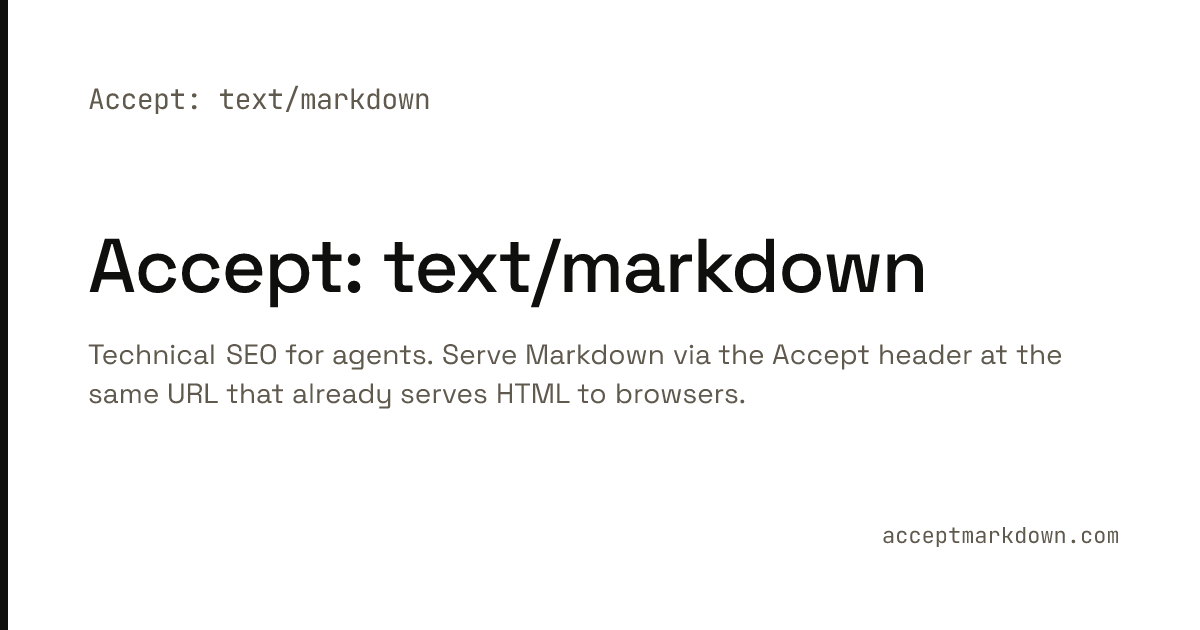
2. Serve Markdown to AI Agents with Accept Headers (acceptmarkdown.com)

Serve Markdown to AI agents and LLMs via the Accept: text/markdown header. Browsers get HTML, agents get clean Markdown.

Learn how to configure your server to deliver Markdown content to AI agents while still providing HTML for browsers, enhancing compatibility and efficiency in content delivery.

4. US sanctions Italian hosting provider for encrypted email to Antifa and PKK (home.treasury.gov)

WASHINGTONβ€”Today, the U.S. Department of the Treasury’s Office of Foreign Assets Control (OFAC) took action to counter the growing threat posed by violent far-left terrorist groups. OFAC sanctioned Autistici Inventati, an Italy-based entity that supplies specialized digital architecture, tools, and …

The U.S. Treasury has imposed sanctions on an Italian hosting provider for allegedly supplying encrypted email services to extremist groups like Antifa and the PKK. This move highlights ongoing efforts to combat digital support for violent organizations.

5. VMs won't contain cyber-capable agents (blog.trailofbits.com)

You can no longer assume a mere VM will contain a sufficiently advanced AI agent.

Virtual machines are no longer guaranteed to house advanced AI agents capable of sophisticated cyber activities, raising concerns about security and functionality. Understanding this shift is crucial for anyone relying on VMs for their operations.

7. GLM-5.3-Flash Intelligence, Performance and Price Analysis (artificialanalysis.ai)

Analysis of Z AI's GLM-5.3-Flash and comparison to other AI models across key metrics including quality, price, performance (tokens per second & time to first token), context window & more.

Z AI’s GLM-5.3-Flash is examined in detail, comparing its performance, pricing, and other critical metrics against competing AI models. This analysis provides insights into its efficiency and value, making it a useful read for those interested in AI technologies.

8. You could have invented PageRank (praveshkoirala.com)

Picture this, the year is 1996. You find yourself frustrated with the incumbent search engines like AltaVista, which primarily does a content-based search (it'll give you an article on "Hotels for Chickens" if you search "Hotels" because the word matches). There's gotta be a better way, right? Well, in hindsight, of course. Sergey Brin and

Imagine being in 1996 and realizing that existing search engines just weren’t cutting it. This piece reflects on the frustrations that led to the creation of PageRank, highlighting the need for a more effective way to search the web.

9. More than half of adults in U.S. say they lack basic statistical understanding (www.psu.edu)

Many people in the U.S. believe that their statistical knowledge is limited, but they would rely on statistics for decision-making more if they understood statistics better, according to a new study led by a Penn State researcher.

A recent study highlights that over half of U.S. adults feel they lack essential statistical knowledge, which affects their confidence in using statistics for decision-making. Understanding these gaps could lead to improved decision-making in various aspects of life.

10. YouTube Format IDs (gist.github.com)

Youtube Format IDs. GitHub Gist: instantly share code, notes, and snippets.

Discover the details of YouTube format IDs and how they can be shared effectively through GitHub Gist. This resource could be useful for developers looking to manage video formats.

15. Show HN: We built the smallest dual-band aircraft tracker (pantsforbirds.com)

A team has developed a compact dual-band aircraft tracker using new technology from Semtech, building on their experience with open-source ADS-B receivers. They invite questions about their hardware innovations and the manufacturing process behind this miniaturization.

16. U.S. gov't moves to suppress pushback on data centers (www.tomshardware.com)

States would then need to choose if they want to solicit public feedback for permits.

The U.S. government is considering new measures that could limit public input on data center permits, leaving states to decide whether to seek community feedback. This shift raises questions about transparency and local involvement in the development of tech infrastructure.

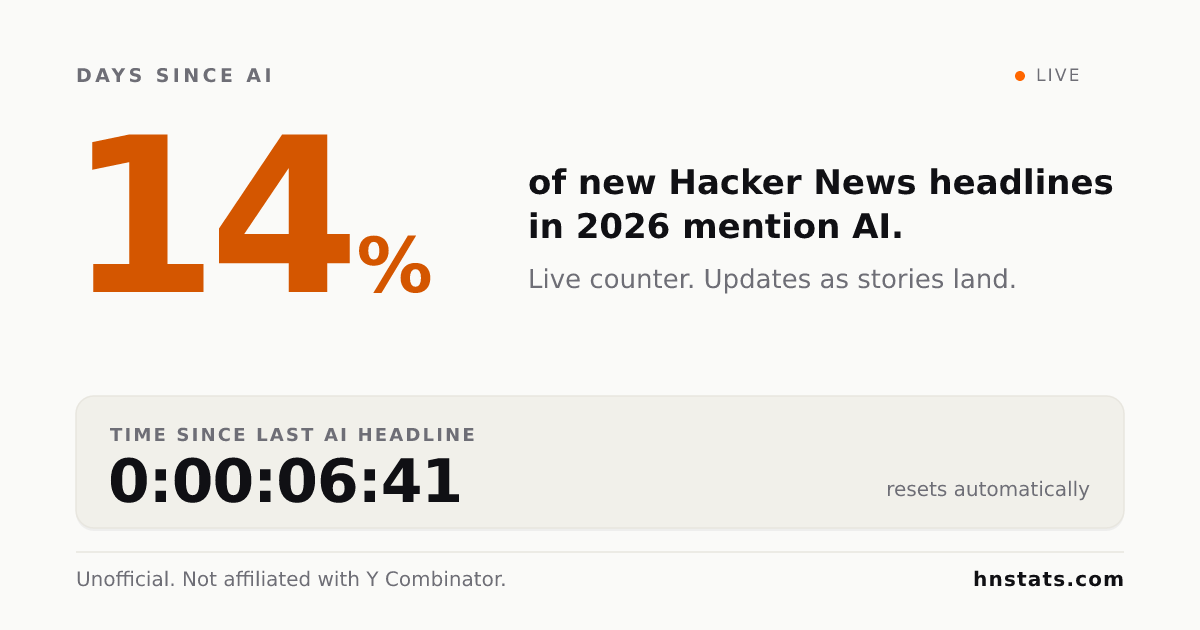
20. Show HN: How much of Hacker News is AI? (hnstats.com)

Live count of how many new Hacker News headlines mention AI today. Updates as stories are posted. Timer resets on each new AI headline.

A new tool analyzes the prevalence of AI-related content on Hacker News, revealing trends in how often the term appears in titles. With stats showing a significant rise over the years, it offers insight into the growing focus on artificial intelligence in tech discussions.

22. Radiation link in flight attendant's breast cancer, French court finds (www.bbc.com)

Former Air France stewardess Sophie Lainault has had her cancer recognised as an occupational disease.

A French court has ruled that the breast cancer of former Air France stewardess Sophie Lainault is linked to her occupation, marking a significant acknowledgment of the health risks faced by flight attendants. This case could have implications for how occupational diseases are recognized in the aviation industry.

23. Value Classes Still Need Compiler Sympathy (johan-sjolen.github.io)

This post discusses preview features in JDK 28\nJEP 401, a major Valhalla milestone, has been integrated as a preview feature in JDK 28. This is very exciting, as value classes increase both our ability to communicate the semantics of our programs to others and the optimization opportunities available to the JVM.\nHowever, I have seen people online essentially taking a "Value all the classes!" approach to this. I worry that there is a belief that ordinary classes give you a floor on performance, and that value classes will do their best to raise you above that floor, but won't ever take you below it. Unfortunately, that is not true. A well-intentioned program may put the JVM into a situation where a flattened representation is faster for some methods, and a reference representation is faster for others. When these methods interact, the JVM is forced to convert between the two representations. I want value classes to be more than just magic, so today I am going to show you what the JVM is capable of right now, and where its limitations are. I hope that with this you'll have some context for reasoning about the code that you (or your AI agent) write.\n

JDK 28 introduces preview features related to value classes, marking a significant step in Project Valhalla. The piece addresses both the potential benefits of value classes for program semantics and performance, while cautioning against the misconception that they automatically enhance all classes’ performance.

24. Agentic Context Management: Memory and Cost as Architecture Problems (arxiv.org)

Production AI agents' failures are less often due to an inability to reason well and more often because they cannot manage what is in their reasoning context: conversation histories, large prompts, large tool definitions, and ballooning tool outputs. Agents drown in their own accumulating history while paying a token cost that grows every turn, producing missing recalls within and across conversations. The incumbent response treats this as a storage-and-retrieval problem. We argue that framing is too narrow. Actively managing what an agent holds in mind is a lifecycle, not merely a store: it spans deciding what to remember, extracting and structuring it, choosing the right store per data type, consolidating and forgetting while preserving provenance, deciding what is relevant now, anticipating what is needed next, and compacting context to a budget without losing what matters. In serious production this operates not over a single user but across an organizational scope hierarchy. We name this discipline Agentic Context Management (ACM) and decompose it into five primitives: architecting, ingesting, scoping, anticipating, and compacting & consolidation. We then make the economic case: naive context accumulation grows token cost quadratically in conversation length, crude summarization buys linear cost at the price of an accuracy cliff, and only validated compaction achieves linear cost with preserved fidelity. We describe a reference implementation, Maximem Synap, that realizes the five primitives as a multi-tenant service and reports 92% on LongMemEval and 93.2% on LoCoMo under the configuration detailed in Section 6. We close with dimensions existing benchmarks do not yet capture, latency, token efficiency, and context-rot resistance, and the frontier of decision-level and organization-level context the category points toward.

AI agents struggle with managing complex conversation histories and outputs, leading to failures in reasoning. The article discusses how this issue is often misidentified as a storage problem, suggesting a need for a new approach to improve their performance.

28. Disrupting a new covert influence campaign from Russia (openai.com)

OpenAI banned Russia-origin accounts using AI to promote a fake Israel-based think tank and a β€œsovereignty” index praising Russia and criticizing the West.

OpenAI has taken action against accounts linked to Russia that were using AI to disseminate misinformation about a fictitious think tank and promote a skewed narrative favoring Russia. This move highlights the ongoing battle against covert influence operations in the digital space.

29. Show HN: Build your own theme park (www.magicpatterns.com)

Create your own theme park in seconds. Describe the roller coasters, rides, attractions and scenery you want, and watch your park come to life.

An engineer has developed an AI agent that lets you create custom theme parks reminiscent of Rollercoaster Tycoon, generating cohesive designs based on simple prompts. The project applies techniques from AI-generated websites, showcasing an innovative intersection of gaming and design technology.

30. Wiped out: US faces surging toilet paper prices amid trade war with Canada (www.theguardian.com)

Paper products among hardest-hit sectors after trade negotiations broke down, with 25-50% tariffs estimated

The breakdown in trade negotiations with Canada is causing significant price hikes in toilet paper and other paper products, with tariffs reaching as high as 50%. This surge in costs could impact consumers and retailers across the US.

Article Details

Browse by Date

Type to search HN and engineering blog articles
Press Escape to close  |  ↑↓ to navigate  |  Enter to open