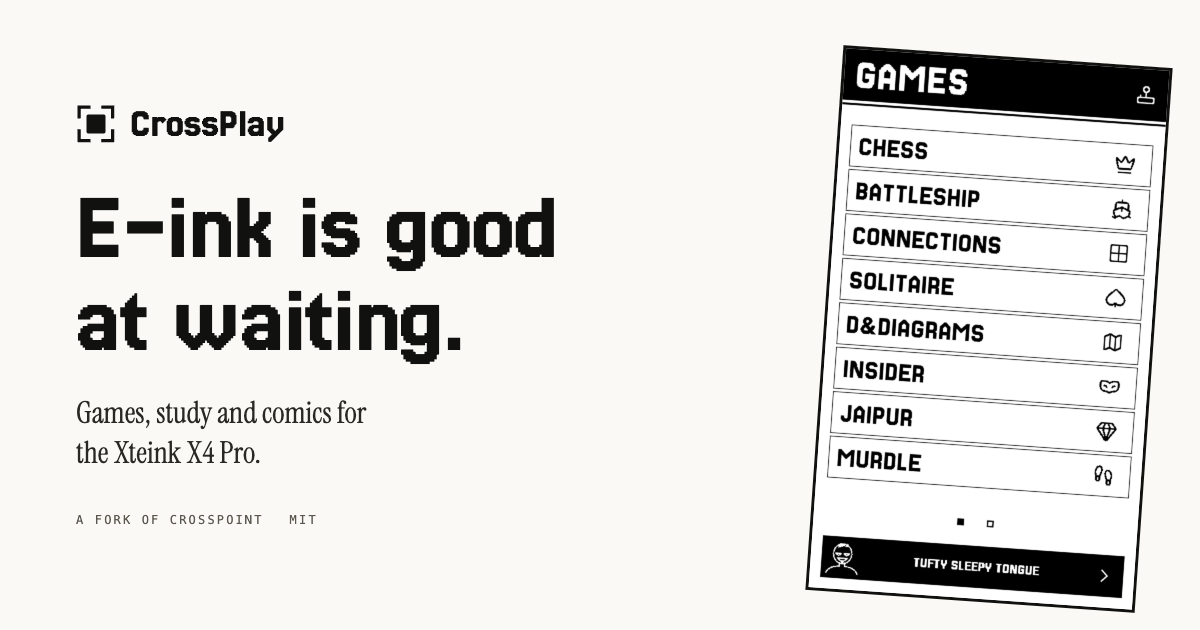
1. Building a local positioning system to track runners using Ultra-Wideband (zeus.ugent.be)

An open-source multi-tag fully local UWB positioning system.

A new open-source project utilizes Ultra-Wideband technology to create a local positioning system that can track multiple runners. This innovative approach offers a precise way to monitor performance in real-time without relying on external signals.
2. From your doorbell to your home network (adepts.of0x.cc)

Analyzing Eufy Security Ecosystem and reverse engineering of its doorbell component

The article investigates the Eufy Security Ecosystem, focusing on a detailed reverse engineering of its doorbell component. It reveals insights into how the device integrates with home networks and its security implications.

4. No One Can Afford to Make Myst Games Anymore (www.wired.com)

“Myst” sold over 6 million copies in the ’90s. Its latest spinoff couldn’t shore up any funding, pointing to an existential crisis among double-A games.

The decline of funding for games like the latest “Myst” spinoff highlights a troubling trend in the double-A game market, raising questions about the future of mid-tier titles. With the original “Myst” selling millions, the challenges facing similar games today suggest a significant shift in the gaming landscape.

5. Monitors for Work (etbe.coker.com.au)

The Corporate Monitor Issue Some time ago I worked in the IT department of a company that had a corporate standard of two 27″ FUllHD (either 1920*1080 or 1920*1200) monitors for the desktop. …

Many companies have adopted a standard of using dual 27-inch Full HD monitors for their workstations to enhance productivity. This article discusses the benefits and challenges of this setup based on firsthand experience in an IT department.

6. BYOC Is Not Just 'Deploy into Their Cloud' (omnistrate.com)

Delivering software directly to customer clouds solves data gravity, yet operating across diverse environments requires a robust product architecture.

Deploying software directly into customer clouds addresses data gravity challenges, but it also demands a strong product architecture to manage various environments effectively. This piece discusses the complexities and solutions involved in this approach.

7. ao486: x86-compatible Verilog core implementing all features of a 486 SX (2014) (github.com)

The ao486 is an x86 compatible Verilog core implementing all features of a 486 SX. - alfikpl/ao486

The ao486 project offers a complete Verilog implementation of the 486 SX, enabling developers to work with a fully compatible x86 core. This could be a valuable resource for those interested in retro computing or hardware design.

8. Mythos social engineering AISI INC-2026-07-28-01 (web.archive.org)

Fixes #2 - discovery hangs when multiple default via routes exist.
What changed

defaultRoute() now parses all default routes and picks the lowest metric (ties: first seen) instead of concatenating...

A recent update addresses a bug where discovery processes would hang due to multiple default routes. The change ensures that the system now selects the default route with the lowest metric, improving stability and performance.

9. k-Coloring is Faster than Computing the Chromatic Number (arxiv.org)

We prove that $k$-coloring on $n$-vertex graphs has a randomized algorithm running in time $(2-\varepsilon_k)^n$, where $\varepsilon_k>0$ for every fixed $k$. Previously, only the cases $k\leq 6$ were known to have faster solutions than the general $O^\star\bigl(2^n\bigr)$ time algorithm of [Björklund, Husfeldt, Koivisto, SICOMP 2009] that computes the chromatic number.
We resolve this long-standing open problem by generalizing and combining tools from the $(k+2)$-coloring to $k$-list-coloring reduction of [Zamir, ICALP 2021] and the hypergraph-containers based approach in [Zamir, STOC 2023]. Together with new algorithms for list-coloring instances mixing long and short color lists, this yields an iterable reduction from $(k+1)$-list-coloring to $k$-list-coloring over fixed palettes.

A new randomized algorithm enables faster $k$-coloring for $n$-vertex graphs, achieving a runtime of $(2-\varepsilon_k)^n$ for any fixed $k$. This advancement surpasses previous methods, which were limited to $k \leq 6$, and addresses a significant open problem in computational graph theory.

13. The USSR in 100 Photographs (trinixy.ru)

Я вообще-то не очень люблю размещать фотографии СССР, так как они уже были везде, где только могли быть. Но эта подборка меня улыбнула. Тут собраны фотографии из различных больших подборок и

A curated collection of Soviet-era photographs brings a fresh perspective, featuring images that may not be widely seen. The selection aims to evoke nostalgia while providing a unique look at a familiar subject.

14. From One Seed to a Thousand Leaves – Merkle's Authentication Tree (0xkrt26.github.io)

The mathematics behind why encryption works — and why it sometimes doesn’t.

The article breaks down the mathematical principles that underpin encryption, highlighting both its strengths and vulnerabilities. Understanding these concepts is crucial for anyone interested in cybersecurity and data protection.

15. The CPU is back: Rethinking the CPU-GPU split for LLM inference (www.redhat.com)

Why agentic AI is driving the shift back to CPU inference.

The article discusses how the rise of agentic AI is prompting a reevaluation of using CPUs for LLM inference instead of relying solely on GPUs. It highlights the implications of this shift for AI performance and efficiency.

18. Sensitive Info Goes into 'No Reply' Emails Constantly. This Guy Sees It All (www.wired.com)

Two security researchers bought cheap domains—including noreply.net and deleteduser.com—and set up email listening services. Hundreds of companies are sending them corporate secrets.

Two security researchers have uncovered a startling trend: by acquiring inexpensive domains, they’ve been receiving sensitive corporate information from numerous companies through “no reply” emails. This raises significant concerns about data security and the oversight of email practices in business communications.

19. Captain Bible Reverse Engineering (github.com)

Reverse engineering of Bridgestone Multimedia Group's 1994 classic, "Captain Bible in the Dome of Darkness" - peterkelly/captain-bible-re

A reverse engineering project is uncovering the details of the 1994 video game “Captain Bible in the Dome of Darkness,” originally created by Bridgestone Multimedia Group. This initiative aims to analyze and understand the game’s mechanics and design.

22. Building a Rust Inference Engine That Matches Llama.cpp (www.fratepietro.com)

Why I built Ferrox, a pure-Rust GGUF inference engine, and what it took to match llama.cpp’s performance on real models — with receipts, not vibes.

Ferrox is a new inference engine developed in Rust that aims to match the performance of llama.cpp for real models. The author details the challenges faced during its creation and provides concrete evidence of its capabilities.

27. Curlese, Five Years Later (www.hypertesto.me)

Five years ago I argued that curl is the only language every team speaks when an integration breaks. A revisit: what changed, what didn

Curl remains a crucial tool for teams dealing with integration issues, but five years later, the landscape has shifted. This piece reflects on the evolution of curl and its relevance in today’s tech environment.

28. Show HN: A free DOCX editor with MCP server for editing (revise.io)

Connect Claude Desktop, ChatGPT, Codex Desktop, OpenClaw, or any MCP-capable assistant to Revise. Agents can draft, edit, export, and share documents on your behalf — even before you have an account. Includes the full tool-by-tool reference.

Article Details

Browse by Date

Type to search HN and engineering blog articles
Press Escape to close  |  ↑↓ to navigate  |  Enter to open