4. Substack writers, you need a website (elizabethtai.com)

Substack is convenient, but treat it as a distribution tool for your content. Your content should live on an independently owned website, which has a domain name you control and own. This way, you …

Using Substack as a distribution tool is beneficial, but it’s crucial for writers to establish their own websites to maintain control over their content. Owning a personal domain ensures better visibility and ownership in the long run.

5. OpenAI just open-sourced Codex Security (github.com)

SDKs and CLI for Codex Security. Contribute to openai/codex-security development by creating an account on GitHub.

OpenAI has made Codex Security available as open-source, providing SDKs and a command-line interface for developers. This move invites contributions on GitHub, enhancing collaboration in security tool development.
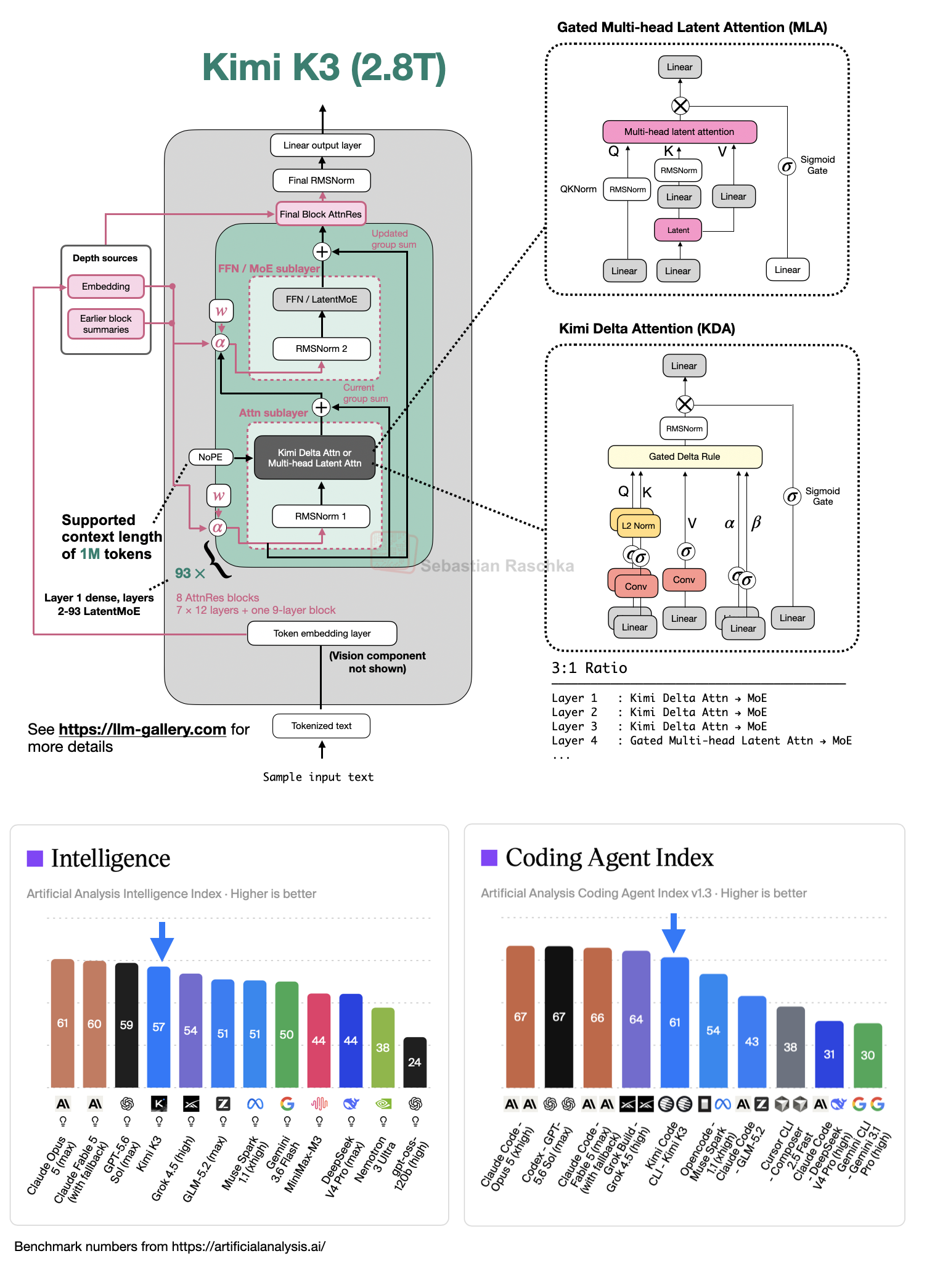
6. Kimi K3 Architecture Overview and Notes (sebastianraschka.com)

Short architecture note on Kimi K3, including LatentMoE, Kimi Delta Attention, Attention Residuals, NoPE, multimodality, and inference-efficiency choices.

The overview details key components of the Kimi K3 architecture, highlighting innovations like LatentMoE and Kimi Delta Attention, as well as strategies for improving inference efficiency and supporting multimodal inputs. It’s a concise resource for understanding the technical advancements in this architecture.

9. Show HN: I was tired of opening 2 tabs for every HN link, so I made a userscript (github.com)

A lightweight userscript that adds Hacker News discussions to any article. - twalichiewicz/HNewhere

A developer created a userscript that combines article links and their discussions from Hacker News into a single interface, eliminating the hassle of switching between tabs. This tool enhances the reading experience by allowing users to view comments alongside the content seamlessly.

11. Delayed Gratification – Proud to Be 'Last to Breaking News' (www.slow-journalism.com)

The Slow Journalism Magazine | Last to breaking news

A publication emphasizes the value of slow journalism, prioritizing in-depth analysis over immediate news coverage. By focusing on thoughtful reporting, it aims to provide a richer understanding of events rather than just the latest updates.

12. A $500 RL fine-tune of a 9B open model beat frontier models on catalog review (fermisense.com)

Why the companies winning in the AI age own their intelligence: a task-trained open source model vs the frontier, with every number published.

A task-trained open source model achieved better performance than leading frontier models in catalog review, highlighting the competitive edge of companies that effectively leverage AI. The analysis includes detailed metrics that illustrate this surprising outcome.

14. Kimi Linear: An Expressive, Efficient Attention Architecture (arxiv.org)

We introduce Kimi Linear, a hybrid linear attention architecture that, for the first time, outperforms full attention under fair comparisons across various scenarios -- including short-context, long-context, and reinforcement learning (RL) scaling regimes. At its core lies Kimi Delta Attention (KDA), an expressive linear attention module that extends Gated DeltaNet with a finer-grained gating mechanism, enabling more effective use of limited finite-state RNN memory. Our bespoke chunkwise algorithm achieves high hardware efficiency through a specialized variant of the Diagonal-Plus-Low-Rank (DPLR) transition matrices, which substantially reduces computation compared to the general DPLR formulation while remaining more consistent with the classical delta rule.
We pretrain a Kimi Linear model with 3B activated parameters and 48B total parameters, based on a layerwise hybrid of KDA and Multi-Head Latent Attention (MLA). Our experiments show that with an identical training recipe, Kimi Linear outperforms full MLA with a sizeable margin across all evaluated tasks, while reducing KV cache usage by up to 75% and achieving up to 6 times decoding throughput for a 1M context. These results demonstrate that Kimi Linear can be a drop-in replacement for full attention architectures with superior performance and efficiency, including tasks with longer input and output lengths.
To support further research, we open-source the KDA kernel and vLLM implementations, and release the pre-trained and instruction-tuned model checkpoints.

Kimi Linear is a new attention architecture that surpasses traditional full attention models in multiple scenarios, including both short and long contexts as well as reinforcement learning tasks. Central to its design is the Kimi Delta Attention module, which enhances memory efficiency through an innovative gating mechanism.

15. Half-Life ported to Mac OS 9 (mac-classic.com)

Tips and tricks to help keep your Mac OS 9/Early Mac OS computers usable today. Software downloads, guides, hacks and news.

Learn how to keep your vintage Mac OS 9 systems running strong with practical tips, software downloads, and useful hacks. Whether you’re a nostalgic gamer or a retro tech enthusiast, these resources will help you enjoy classics like Half-Life on your old machines.

16. You Could Have Come Up with Kimi Delta Attention (blog.doubleword.ai)

Guide to the DeltaNet Family of linear attention mechanisms.

Learn about the DeltaNet family of linear attention mechanisms and how they can enhance your understanding of attention models in machine learning. This guide breaks down their features and applications in a clear manner.

19. Una Watch: Garmin watch competitor but repairable, open ecosystem and USB-C (unawatch.com)

The GPS Watch Built For Life. Designed to be sustainable, without the compromise in performance. Repairable. Upgradable. Sustainable.

The Una Watch offers a sustainable alternative to traditional GPS watches, featuring repairable and upgradable components while maintaining high performance. With a focus on longevity and an open ecosystem, it also comes equipped with USB-C for modern convenience.

23. Discovering Cryptographic Weaknesses with Claude (www.anthropic.com)

Anthropic researchers find weaknesses in cryptographic algorithms with Claude Mythos Preview

Anthropic researchers have identified vulnerabilities in various cryptographic algorithms using their AI model, Claude Mythos Preview. This finding could have significant implications for data security and encryption practices.

24. iPhone Upgrade Program (www.apple.com)

Get a new iPhone every year, and the protection of AppleCare+ with the iPhone Upgrade Program. Buy now or visit an Apple Store today.

The iPhone Upgrade Program allows users to get a new iPhone annually while also including AppleCare+ for device protection. It’s a convenient option for those who want the latest model without the hassle of outright purchasing.

26. Vehicle Motion Cues (support.apple.com)

With Motion accessibility settings on iPhone, get onscreen cues that may help reduce motion sickness while in an on-road moving vehicle.

iPhone’s Motion accessibility settings offer onscreen cues designed to help alleviate motion sickness for users during car rides. Learn how to utilize these features for a more comfortable travel experience.

28. Astronauts describe persistent 'observer' sensation after 6 month missions (spacedaily.com)

Astronauts returning from long ISS rotations consistently describe a half-step-outside-themselves sensation that flight surgeons recognize as part of the post-mission readjustment curve β€” a perceptual cost of spending six months in a body that had to learn a different world.

Astronauts who have spent six months on the International Space Station report a unique sensation of detachment upon returning to Earth. This phenomenon, recognized by flight surgeons, highlights the psychological and perceptual challenges faced during long-duration space missions.
29. DMARC Has Been Public Since 2012. 68.4% of Domains Still Don't Enforce It (ciphercue.com)

DMARC has been public since 2012. We checked 67,336 domains: 68.4% still have no policy or one that does not enforce it.

Despite being available for over a decade, a significant majority of domains still neglect to implement DMARC policies to protect against email spoofing. This analysis of over 67,000 domains highlights the ongoing security risks in email communications.

Article Details

Browse by Date

Type to search HN and engineering blog articles
Press Escape to close  |  ↑↓ to navigate  |  Enter to open