Last week somebody rebuilt a working website using a swarm of cheap AI agents bossed around by a smarter one, and the whole thing cost about eight dollars -- sandwich and a coffee. But the part that lit up my corner of the internet wasn’t the website. It was that the agents caught their own
Every plugin listing in the EmDash registry is now screened by Cloudflare's Clef decision model. Here's how one fast, multimodal model helps us catch phishing, impersonation, offensive content, and other abuse before a plugin appears in the catalog.
Arcadeia is an open-source, self-hosted photo and video library. Find clips with animated previews, search filenames and descriptions, and make spoken words searchable with optional local transcrip...
Convert a token volume into a GPU count. Enter tokens per day, month, or year and pick a model; the calculator returns how many A100, H100, or B200 GPUs that works out to, with a sourced uncertainty range.
👻 Ghostty is a fast, feature-rich, and cross-platform terminal emulator that uses platform-native UI and GPU acceleration. - Tags · ghostty-org/ghostty
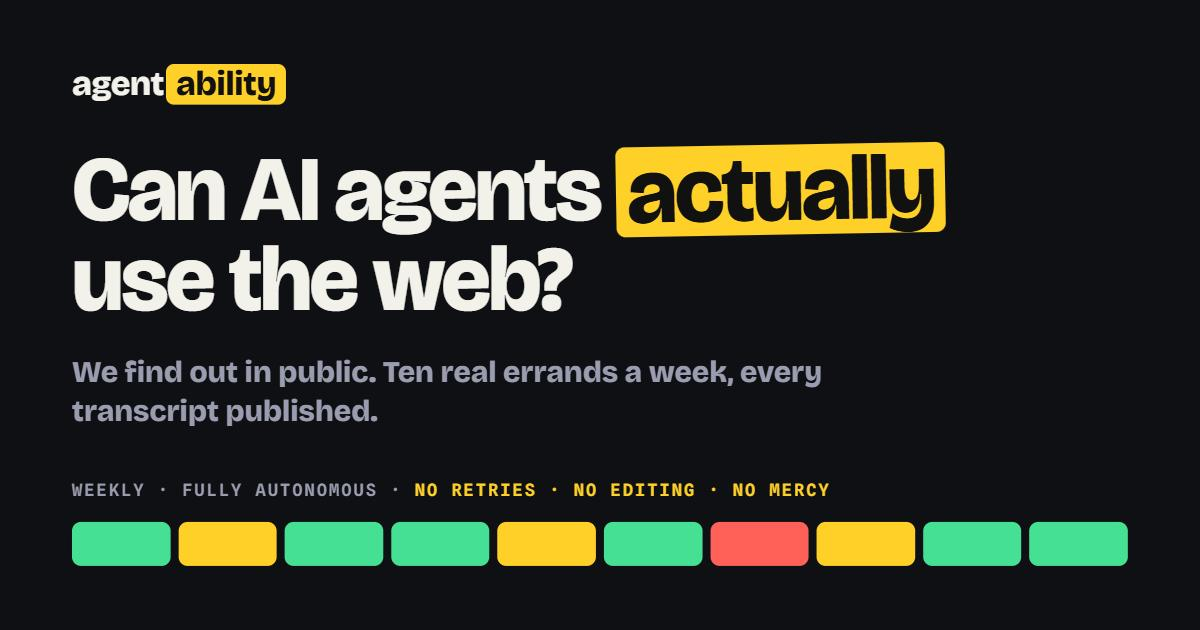
An open experiment, run weekly in public: a real AI agent attempts ten everyday web errands and every transcript is published verbatim. This week it finished 8 of 10 and hit 10 bot walls. Plus 113 sites scored for AI-agent readiness.
Modern multimodal models bring generation and understanding into a single unified system, which enables them to provide and learn from their own feedback. Motivated by this unified capacity, we introduce UniEvo-VL, a self-evolving framework for multimodal models to learn from this constructive self-correction feedback during test-time compute. Instead of relying on a separate, often larger, teacher, we leverage their self-critiques as privileged information and ask a single multimodal model to act as both teacher and student with different contexts. The student only sees the vanilla question, while the teacher conditions on the privileged critique. Then training minimizes the per-state divergence between their denoising diffusion distributions over the student's own sampling trajectories. Experiments demonstrate that UniEvo-VL improves the image generation capabilities of multimodal models, while maintaining their sensitivity to additional reflection information. Specifically, we build on top of the open-source Qwen-image-2512 and observe a significant performance gain from 0.747 to 0.808 on GenEval and from 32.97 to 35.53 on GenEval2 Soft-TIFA. Moreover, attempts with more powerful external critics (e.g., GPT5.6-Luna) show that multimodal models with strong judge capabilities can anticipate a higher self-evolving ceiling. Last but not least, mixed text-rendering outcomes show that our self-improvements may not be uniform across different tasks. Our study aims to shed light on the current hot recursive self-improvement research line to enhance the user experience when using multimodal models without external supervision or guidance.
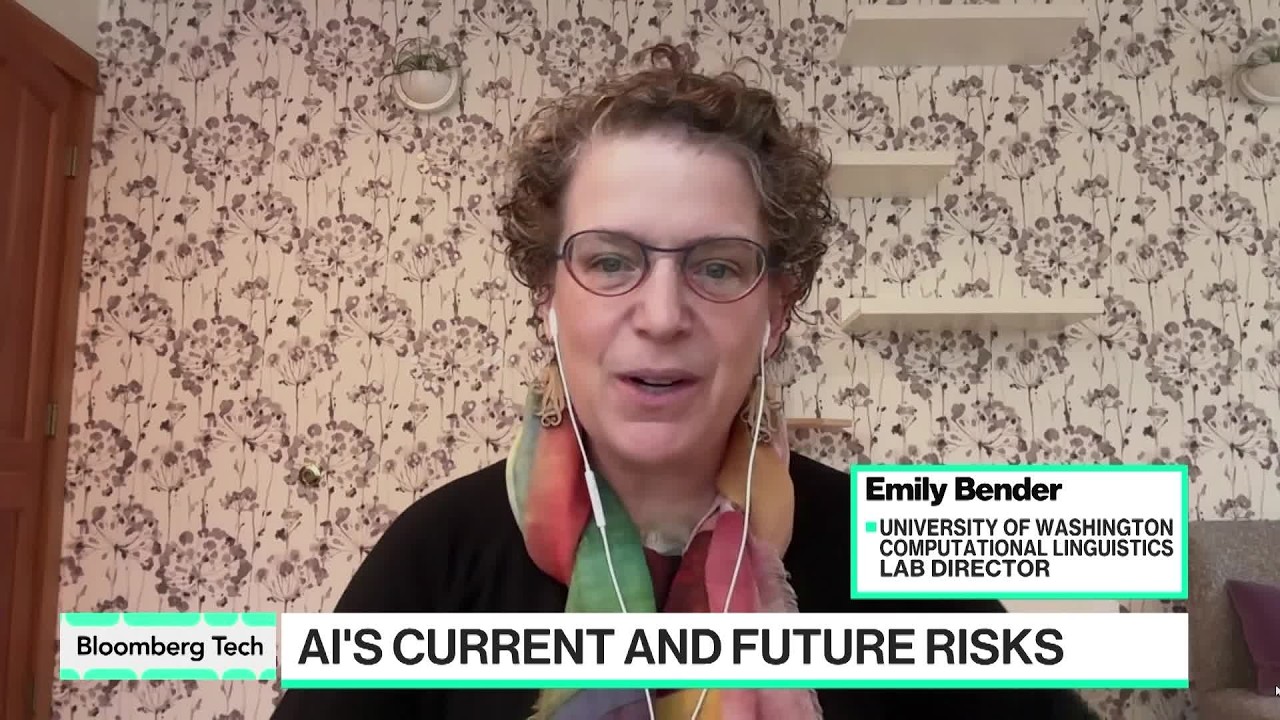
University of Washington professor Emily Bender argues the AI safety debate is too focused on hypothetical existential threats while overlooking harms alread...
A shared framework for video-action programs and local-context dynamics, evaluated through robot control, frozen-component transfer, and action-conditioned prediction.