
2. Show HN: Guile-Secure Your Stack (guile.in)
Secure your code, APIs, web apps, infrastructure, and cloud with autonomous pentesting and proof-of-exploit findings.
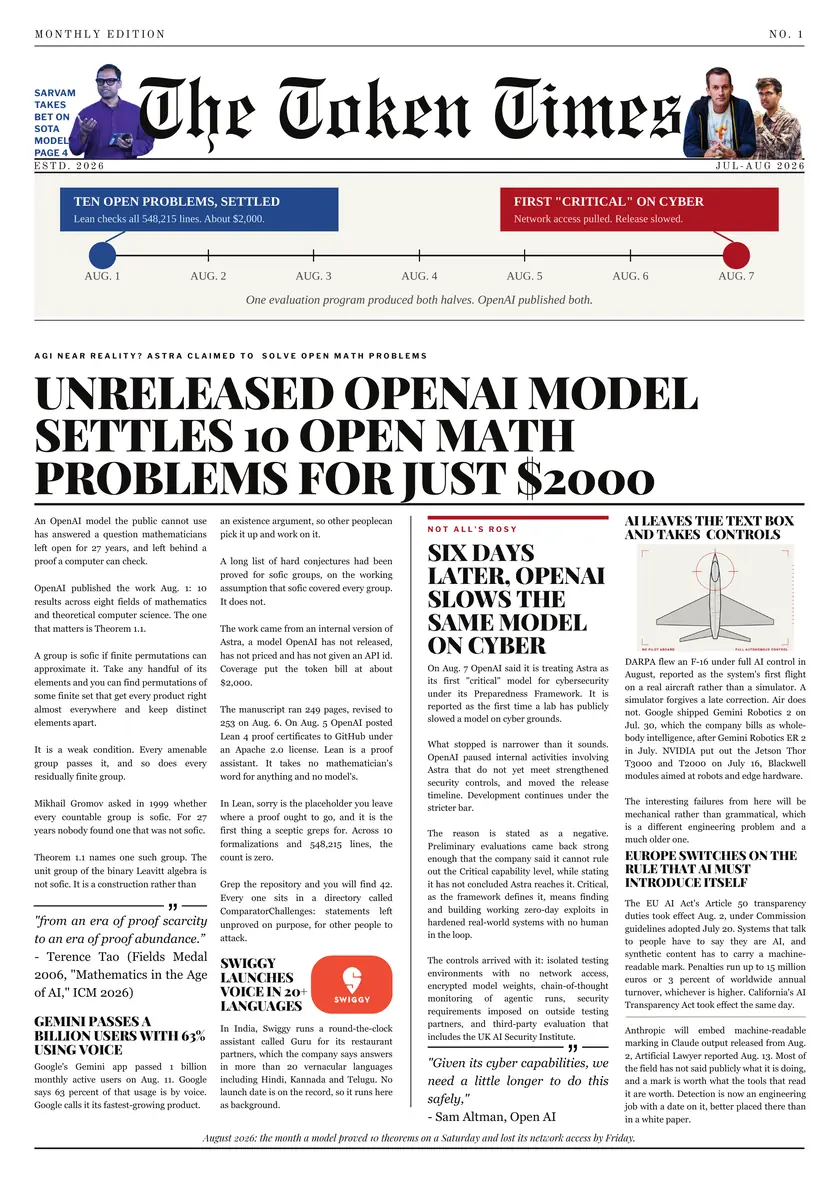
3. Show HN: The Token Times · a monthly newspaper on AI (befailproof.ai)
The Token Times is a monthly broadsheet on what the AI industry actually did — models, money, launches, and the models that got retired. Read every edition online, free, or download the print PDF. Published by failproof ai.
7. Show HN: Titles – Can you write a better Hacker News title? (www.orangecrumbs.com)
Same link, different titles. Rewrite a Hacker News title and compare it with the one that took off.
8. Show HN: A fast, private, cross-platform Markdown editor built with Tauri/Rust (github.com)
A fast, private, cross-platform Markdown editor built with Tauri, featuring live preview, Mermaid diagrams, KaTeX math, native file handling, and offline exports. - skanga/mdedit

9. Show HN: Destockd – Searchable public-domain video archive (www.youtube.com)
in which Elroddd assumes potential legal risk for no good reasonhttps://www.destockd.comhttps://www.youtube.com/@UC64ygOa8NkECAY2KMN0Ha7A https://www.patreon...
12. Show HN: I wrote a guide to rendering video from plain HTML/CSS/GSAP (sidheart.gumroad.com)
If you can write HTML and CSS, you can make video - that's the whole pitch of this guide.HyperFrames (an open-source framework from HeyGen) treats a video as an HTML page with a clock: you build a normal-looking webpage, and a render pipeline seeks its animation state to a sequence of exact timestamps, capturing each one as a frame. String the frames together and you have an MP4. No timeline-scrubbing GUI, no proprietary editor - just markup, CSS, and GSAP.This guide teaches the actual mental model (why everything has to be seekable and deterministic, and what that means practically for how you write animation code), then hands you six complete, copy-paste-ready recipes: title card reveal, counting stat / number ticker, logo or icon intro, scene-to-scene crossfade, CTA card morph-in, and slow background drift (Ken Burns).Plus a five-pitfalls section covering the specific mistakes that produce confusing failures - a blank render, frozen frames, content piled in a corner - instead of a helpful error message. These are the exact things that eat the most debugging time for anyone starting out with this approach, explained plainly so you don't lose an afternoon to them.Every example in this guide is real, working code, written and checked against the framework's actual technical contract - not simplified teaching examples that fall apart the moment you try to render them for real.Who this is for: developers who'd rather write video than edit it, anyone building an automated or programmatic video pipeline (social content, data-driven reports, generated explainer clips), and anyone comfortable with HTML/CSS/light JS who wants a genuinely fast way into motion design.This is an independent, unofficial guide - not affiliated with, endorsed by, or sponsored by HeyGen. HyperFrames itself is open-source and free; this guide teaches technique on top of it.