
2. Nitter is unarchived and will continue (github.com)
Alternative Twitter front-end. Contribute to zedeus/nitter development by creating an account on GitHub.
Nitter, an alternative front-end for Twitter, has been unarchived and is set to continue its development on GitHub. Users interested in privacy-focused social media can now contribute to its ongoing improvements.
3. Intellectual Fly Is Open (bcantrill.dtrace.org)
Note: This was originally published as a LinkedIn post on November 11, 2025.
I need to make a painful confession: somehow, LinkedIn has become an important social network to me. This isn’t necessarily due to LinkedIn’s sparkling competence, of course. To the contrary, LinkedIn is the Gerald Ford of social networks: the normal one that was left standing as the Richard Nixons and the Spiro Agnews of social media imploded around them. As with Gerald Ford, with LinkedIn we know that we’re getting something a bit clumsy and boring, but (as with post-Watergate America!), we’re also getting something that isn’t totally crooked — and that’s actually a bit of a relief.
I need to make a painful confession: somehow, LinkedIn has become an important social network to me. This isn’t necessarily due to LinkedIn’s sparkling competence, of course. To the contrary, LinkedIn is the Gerald Ford of social networks: the normal one that was left standing as the Richard Nixons and the Spiro Agnews of social media imploded around them. As with Gerald Ford, with LinkedIn we know that we’re getting something a bit clumsy and boring, but (as with post-Watergate America!), we’re also getting something that isn’t totally crooked — and that’s actually a bit of a relief.
4. Cloud in a Bottle: making self-hosting accessible to everyone (cloudinabottle.org)
Your open-source personal cloud: containerized apps, unified auth, good UX. Self-hosting should feel like using a smartphone that serves webapps, not a sysadmin side job.
The article discusses a new approach to self-hosting that simplifies the experience, making it as user-friendly as operating a smartphone. It highlights containerized applications and unified authentication to enhance the usability of personal clouds for everyone.
5. A/I shuts down – Stay human (keepitfree.ai)

6. Isar Aerospace reaches orbit and deploys payloads on second flight (isaraerospace.com)
By enabling access to space, we contribute to humanity’s progress and our planet’s sustainable technological and economic development. Select your journey to orbit and launch with us.
7. Chrome again exempts Google from user site data settings (lapcatsoftware.com)
8. The revolt of the reader (bcantrill.dtrace.org)
Reading is important to me. While I’m not a quick reader nor an especially voracious one, I have found that long-form reading has had a profound influence on me over my life.
And because reading is important to me, writing is too: writing not only allows us to convey our ideas, but the very act forces us to test and distill them — at once making our ideas more robust while providing the vehicle by which to share them.
And because reading is important to me, writing is too: writing not only allows us to convey our ideas, but the very act forces us to test and distill them — at once making our ideas more robust while providing the vehicle by which to share them.
The author reflects on the personal significance of long-form reading and its impact on both reading and writing. This piece offers insights into how these practices shape our thoughts and communication.
9. Asahi Linux Now Officially Supports Apple M3 Macs – With Caveats (www.phoronix.com)
10. An Alien Mind (openai.com)
Jakub Pachocki reflects on increasingly capable AI and the challenge of keeping it aligned. He calls for stronger safeguards and international coordination.
Jakub Pachocki discusses the growing capabilities of AI and the urgent need for effective alignment strategies. He emphasizes the importance of international cooperation to establish stronger safeguards for these technologies.
11. Doomscrolling Ourselves to Death (www.edwest.co.uk)
12. GrapheneOS Overhauled Default Apps and Secure Clipboard (grapheneos.social)

13. It took a year to ship WebAssembly in Anubis (anubis.techaro.lol)
After a year of work, hundreds of commits, 5 generations of pull requests, dozens of tests, rewriting part of Anubis in Rust, the first compiler bug of my career, and at least three times making my tower run out of ram I think I have finally done it. The next version of Anubis will ship with WebAssembly-based proof of work checks that admins can enable in their thresholds or bot rules:
After a year of intense development, the next version of Anubis will introduce WebAssembly-based proof of work checks, offering admins new options for managing thresholds and bot rules. The journey involved extensive coding, testing, and even some unexpected challenges along the way.
14. Music Theory for Programmers (runjs.app)
I can't play an instrument, so I worked out music theory in JavaScript instead. Twelve notes, scales and chords, derived from scratch with code you can hear.
Learn how to understand music theory through coding, even if you can’t play an instrument. The article details how to create sounds and musical concepts using JavaScript, making it accessible for programmers.
15. Ask HN: How do you manage skills files?
A user is seeking advice on organizing and maintaining skills files, questioning their relevance as model capabilities advance. The discussion touches on practical strategies for skill management and continuous improvement.
16. Following legal advice, the Nitter project will continue (github.com)
Alternative Twitter front-end. Contribute to zedeus/nitter development by creating an account on GitHub.
The Nitter project, an alternative front-end for Twitter, is moving forward after receiving legal guidance. Users interested in contributing can join the development on GitHub.


18. You Don't Have a Right to Safe Drinking Water, US Court Rules (www.motherjones.com)
A Trump-appointed judge also said Americans have no “constitutional right to truthful information” during a public health crisis.
A recent court ruling states that Americans do not have a constitutional right to safe drinking water or truthful information during public health emergencies, raising significant concerns about public health protections and accountability. This decision could have far-reaching implications for how health crises are managed in the future.
19. Research acceleration: The view inside OpenAI (openai.com)
Inside OpenAI, coding agents are reshaping AI research. Explore early data on agent usage, experiment velocity, task complexity, and research acceleration.
OpenAI is leveraging coding agents to enhance the pace and complexity of AI research. The article presents early data that highlights how these agents are transforming experimentation and productivity in the field.
20. Icy Moons Are Ocean Worlds (mceglowski.substack.com)

21. M-DISC – DVD/Blu-ray compatible discs that may last up to 1000 years (en.wikipedia.org)
22. Babylonian Lamb Stew with Beets (1750–1730 BCE) (babylonian-collection.yale.edu)
23. NetBSD 9.5 released and EOL for NetBSD-9 (blog.netbsd.org)
24. AI, Tools and Transformation (www.ben-evans.com)
It’s very tempting to imagine that AI turns everyone into a tool-builder - now everyone can just ask the model to make the software they need, and apps as we know them are dead. I think that misunderstands how most people think and where software actually comes from, and more importantly, it isn’t
The article challenges the notion that AI will democratize software development, arguing that it overlooks the complexities of how people create and use tools. It emphasizes the ongoing importance of human creativity in the software landscape.

25. I Changed My License (bergie.iki.fi)
In the last 28 years of publishing software, I’ve had three distinct eras of software licensing. All of my recent stuff is available under the European Union Public License 1.2, and I thought to explain why.
After nearly three decades in software publishing, the author reflects on their journey through three different licensing eras and shares the reasons behind their recent choice of the European Union Public License 1.2 for new projects. This insight provides a unique perspective on the evolving landscape of software licensing.
27. The ColorChecker, photography's most important 24 squares, turns 50 (www.dpreview.com)
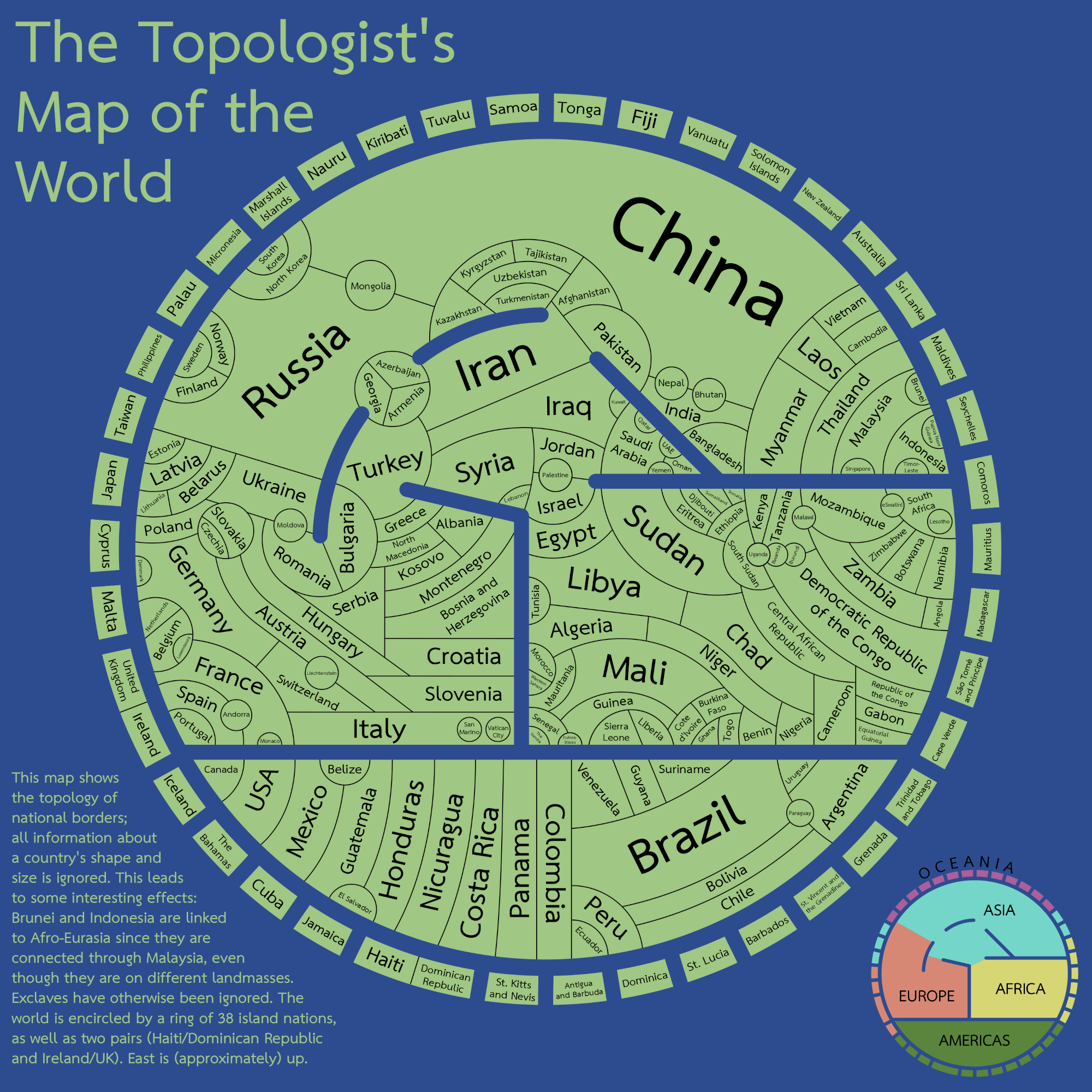
28. Topologist's Map of the World (www.futilitycloset.com)
Reddit user xilefakamot created this in 2020 — a “topologist’s map of the world.” It depicts international borders and nothing else — the shapes, sizes, and distances between countries are forsaken in order to present the pattern of their borders as efficiently as possible. “No calculations per se – I sketched out a series of networks showing which countries bordered each other, then gradually smoothed them out to make the map – all done manually.” (Via MapPorn.)
A Reddit user has crafted a unique map that prioritizes the patterns of international borders over geographical accuracy. This artistic interpretation highlights the connections between countries in a visually striking way, showcasing a different perspective on global geography.

29. Harnessing the Universal Geometry of Embeddings (arxiv.org)
We introduce the first method for translating text embeddings from one vector space to another without any paired data, encoders, or predefined sets of matches. Our unsupervised approach translates any embedding to and from a universal latent representation (i.e., a universal semantic structure conjectured by the Platonic Representation Hypothesis). Our translations achieve high cosine similarity across model pairs with different architectures, parameter counts, and training datasets.
The ability to translate unknown embeddings into a different space while preserving their geometry has serious implications for the security of vector databases. An adversary with access only to embedding vectors can extract sensitive information about the underlying documents, sufficient for classification and attribute inference.
The ability to translate unknown embeddings into a different space while preserving their geometry has serious implications for the security of vector databases. An adversary with access only to embedding vectors can extract sensitive information about the underlying documents, sufficient for classification and attribute inference.
A new unsupervised method allows for the translation of text embeddings between different vector spaces without needing paired data or predefined matches. This approach not only facilitates cross-architecture compatibility but also demonstrates high similarity in semantic representation, offering insights into the Platonic Representation Hypothesis.

30. AMD Based FreeBSD Desktop Reloaded (vermaden.wordpress.com)
My previous AMD Based FreeBSD Desktop is still up and running – it will now be my kids computer … so I needed a new one … but not a bigger one :) I spent way too much time finding…
A tech enthusiast shares their journey in building a new, compact AMD-based FreeBSD desktop after repurposing their old one for their kids. The article details the challenges faced in the process and offers insights for anyone considering a similar setup.