1. Human vs. AI – Diff-based line-level provenance for text under agentic editing (github.com)

Line-level provenance for text under agentic editing β€” who wrote this line, us or them? β€” derived from version history, not from markup in the file. - eighttrigrams/us-vs-them

The article discusses a method for tracking the origin of text edits, distinguishing between human and AI contributions by analyzing version history rather than relying on file markup. This approach raises important questions about authorship in the age of AI-generated content.

2. Show HN: Airy – Free, fast, and simple voice content creation (airy.so)

Airy Studio β€” Turn lines into speech. Choose a voice and export audio.

Airy Studio allows users to convert text into speech easily and quickly, offering a selection of voices for audio export. It’s a straightforward tool for anyone looking to create voice content without hassle.

6. The phone book that led us to Assad's spy chief in hiding (www.bbc.com)

How we tracked down "The Spider" who was once one of the most-feared men in Syria.

An investigative piece reveals how researchers used a phone book to locate β€œThe Spider,” a notorious figure linked to Syria’s intelligence operations. The story uncovers the challenges and methods involved in tracking down a high-profile individual in hiding.

8. ChatGPT starts blocking direct requests to copy an author's style (arstechnica.com)

New behavior capturing a writer's "broad qualities" could have legal implications.

ChatGPT’s new feature that captures a writer’s general style raises questions about copyright and intellectual property rights. The shift could significantly impact how users interact with AI writing tools.

10. 70% of AI revenue comes from OpenAI and Anthropic (www.youtube.com)

β€œIf 70% of AI revenues are these two companies, there is no AI industry.”Writer of Where’s Your Ed At and the host of the Better Offline podcast Ed Zitron jo...

Ed Zitron argues that the dominance of OpenAI and Anthropic in the AI market raises concerns about the sustainability of the industry, suggesting that true competition is lacking. His insights challenge the perception of a thriving AI ecosystem.

13. Show HN: Alphabet Soup, a multiplayer game, build the longest word to win (alphabetsoup.club)

Alphabet Soup is a multiplayer game where players compete to spell the longest word possible from 7 random letters.

Alphabet Soup is a multiplayer word game where players compete to create the longest word for points, shifting the focus from quantity to quality. You can challenge friends in private matches or test your skills against others in public arenas.

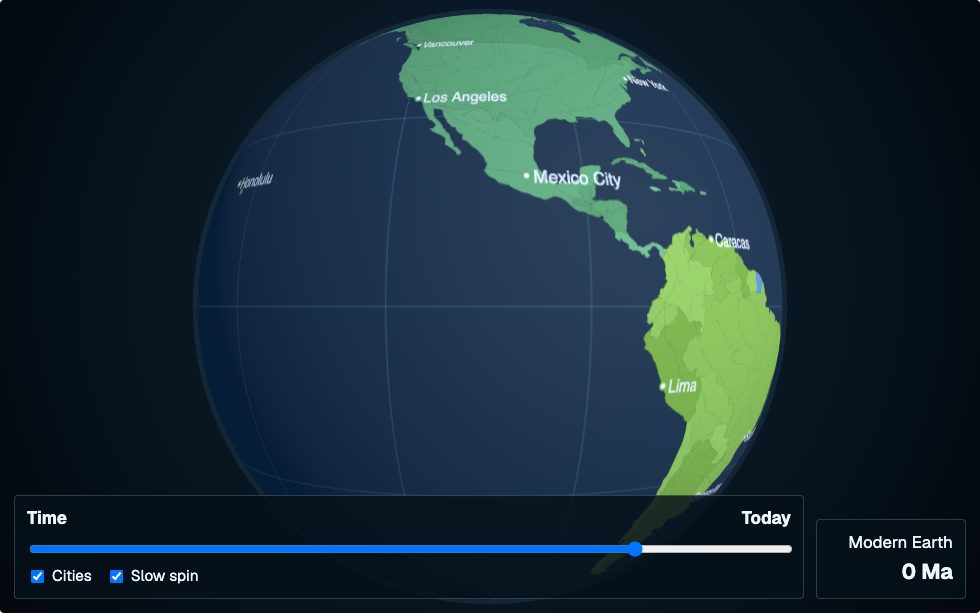
14. Show HN: Today's cities on a globe of Earth's tectonic past and future (douwe.com)

A rotatable Earth that drags today's countries and major cities through the Merdith 2021 plate reconstruction model, plus a simple future extrapolation. Continents keep their color families while the land follows plate motion from 1000 million years ago to 250 million years ahead.

Interact with a dynamic globe that visualizes how today’s cities and countries will shift over millions of years based on tectonic plate movements. This tool not only highlights past continental positions but also offers a glimpse into the future geography of our planet.

16. Why MySpace fans want it back as relaunch hinted (www.bbc.com)

Fans and creators say a revived MySpace must feel personal, not algorithm-driven.

Fans of MySpace are advocating for a relaunch that prioritizes personal connections over algorithmic content, emphasizing the importance of community and creativity in any revival.

18. Israeli startup was linked to rogue AI hacks at OpenAI, Anthropic and Meta (www.cnbc.com)

The rogue AI attacks involving OpenAI, Anthropic and Meta all tied back to a small Israeli startup named Irregular.

A small Israeli startup called Irregular has been identified as the connection behind recent rogue AI attacks targeting major companies like OpenAI, Anthropic, and Meta. The implications of this link raise important questions about cybersecurity in the AI landscape.

21. Show HN: DeepSeek-V4 Latent Reasoning – moving "thinking" into latent space (blog.n.ichol.ai)

DeepSeek-V4-Flash-0731-Latent-Reasoning. A self-contained model that does thinking in latent space, NVFP4-quantized, with a production vllm form for serving runtime.
https://huggingface.co/nmitchko/De

A new self-contained model, DeepSeek-V4, performs reasoning in latent space and is designed for efficient runtime serving. It utilizes NVFP4 quantization for enhanced performance, making it a notable advancement in AI model architecture.

24. Title 7 Disparate Impact Liability Makes Almost Everything Presumptively Illegal (www.nyujll.com)

In Griggs v. Duke Power Co. (1971), the Supreme Court, against the overwhelming weight of the evidence, interpreted Title VII to prohibit not just conscious and unconscious discrimination but also disparate impact, subject to an affirmative defense of business necessity. One problem is that, if di

The Supreme Court’s interpretation of Title VII in Griggs v. Duke Power Co. has significant implications for how discrimination is assessed, extending beyond intentional bias to include practices that result in disparate impact. This raises critical questions about what constitutes legal employment practices in the face of potential discrimination claims.

26. The AI Apocalypse Is Here (www.compactmag.com)

Americans do not care for artificial intelligence. Recent polling shows that their attitudes mostly range from ambivalence to horror.

Polls reveal a stark divide in American sentiment towards artificial intelligence, with many expressing fear or indifference. Discover the reasons behind this growing unease and what it could mean for the future of AI development.

28. A partial digestion of the HRT counterexample (terrytao.wordpress.com)

A function $latex {f(t) \in L^2({\bf R})}&fg=000000$ of one variable can be translated in space by a spatial shift $latex {x}&fg=000000$ to obtain a new function $latex \displaystyle \pi(x,…

29. Literary Sins (www.thedial.world)

Bad habits and secret pleasures.

The article discusses the unspoken vices and guilty pleasures that often accompany reading and writing. It sheds light on how these literary sins can shape our experiences and relationships with literature.

30. When Feature Flags Do and Don't Make Sense (software.rajivprab.com)

Over the past years, I’ve worked in multiple teams adopting very different strategies when it comes to feature flags. I’ve seen the pros and cons of both, and over time, I found myself disagreeing …

The author shares insights from their experience with various teams to highlight the advantages and drawbacks of using feature flags in software development. Their reflections aim to clarify when implementing feature flags is beneficial and when it may not be the best choice.

Article Details

Browse by Date

Type to search HN and engineering blog articles
Press Escape to close  |  ↑↓ to navigate  |  Enter to open