
2. LLMs reward expertise (www.seangoedecke.com)

3. Qwen3.8-Max: A New Bar for Coding and Cowork (qwen.ai)
Qwen Studio offers comprehensive functionality spanning chatbot, image and video understanding, image generation, document processing, web search integration, tool utilization, and artifacts.
Qwen Studio introduces Qwen3.8-Max, a versatile tool that combines chatbot capabilities with advanced image and video processing, document handling, and web search features. This all-in-one platform aims to enhance productivity for coding and collaborative work.
4. Critical CVE issued for hallucinated SQLite vulnerability (research.jfrog.com)

5. Devtools must be open source (blog.exe.dev)
The age of personalized software is here.
6. Ten advances in mathematics and theoretical computer science (openai.com)
OpenAI shares new results on long-standing open problems in mathematics and theoretical computer science, including advances in geometry, cryptography, and complexity.
OpenAI has made significant progress on longstanding problems in mathematics and theoretical computer science, highlighting breakthroughs in areas like geometry, cryptography, and complexity theory. These findings could reshape our understanding of these fields.

7. More German than many Germans (mertbulan.com)
I just wanted to do an internship in Europe so it would be easier to find a job after graduation. That internship completely changed my life.
An internship in Europe turned into a transformative experience for one individual, reshaping their career path and life in unexpected ways. Discover how this opportunity led to profound personal and professional growth.
8. Prevent cognitive debt by manually retyping LLM-generated code (ankursethi.com)
10. Bonsai: Janestreet's UI Library (github.com)
A library for building dynamic webapps, using Js_of_ocaml - janestreet/bonsai
Janestreet’s Bonsai is a UI library designed for creating dynamic web applications using Js_of_ocaml. Discover how it enables efficient web development with a functional programming approach.
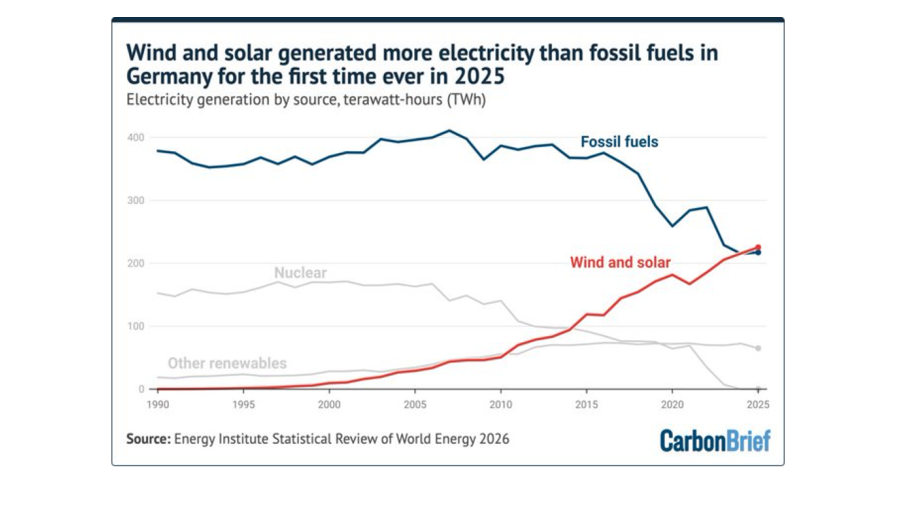
11. Wind and solar overtake fossil fuels in Germany for the first time (www.intellinews.com)
More of Germany

12. Show HN: Isopolis – isometric pixel map of SF (sf.isopolis.city)
San Francisco as one giant isometric pixel painting. Pan the city, open the tours, send a postcard.
Experience San Francisco in a unique way with an isometric pixel art map that allows you to explore the city, take virtual tours, and even send digital postcards. This creative project offers a fresh perspective on the iconic cityscape.

13. Andy Pavlo Joins ClickHouse to Establish ClickHouse Labs (clickhouse.com)
I am excited to announce that I am joining ClickHouse, Inc. to establish and lead a new research team at ClickHouse Labs.
Andy Pavlo is taking the helm at ClickHouse Labs, where he will lead a new research team focused on advancing the capabilities of ClickHouse, Inc. This move signals an exciting development for the database management landscape.
14. MiniMax H3 Day-0 Support in ComfyUI: Open Weights, Native Audio, and 2K Video (blog.comfy.org)

15. Taylor Farms Has Rewritten Its Cyclospora Statement Four Times in Sixteen Days (www.marlerblog.com)
A company’s public statement in the middle of an outbreak is not marketing. It is evidence — what the company said it knew, and when, published to the
Taylor Farms has revised its statement regarding the cyclospora outbreak multiple times in a short span, raising questions about its transparency and response to the situation. This ongoing situation highlights the importance of clarity and accountability in public health communications.
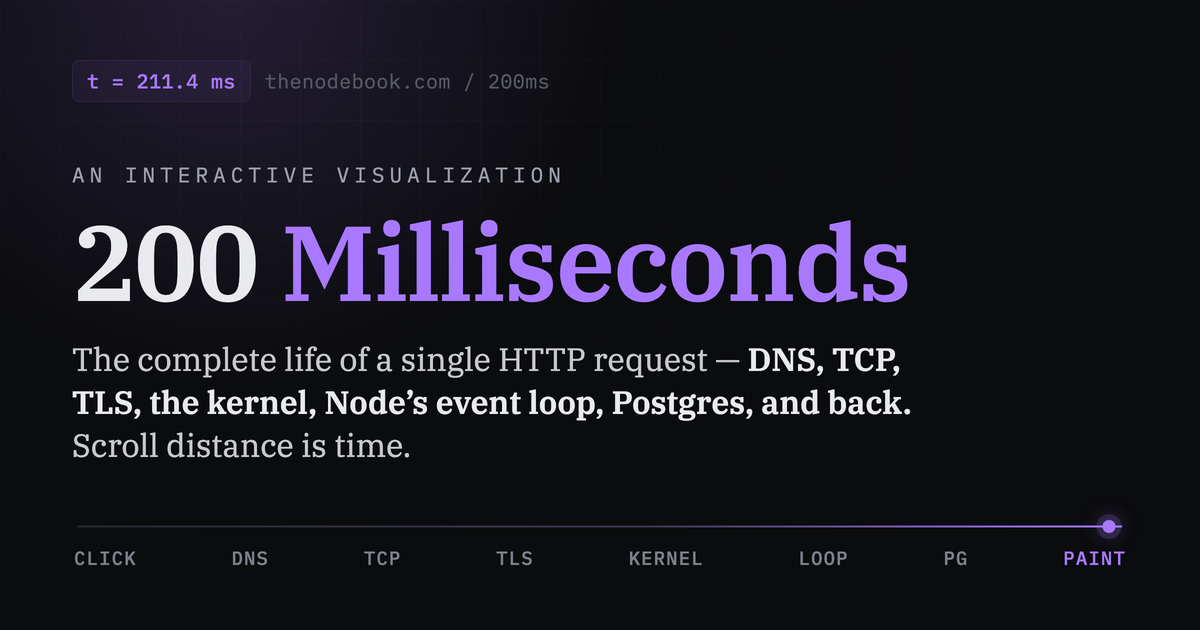
16. 200 Milliseconds (200ms.thenodebook.com)
Scroll through the complete life of one HTTP request in real time — from a click in a coffee shop through DNS, TCP, TLS, the kernel, Node
Experience the journey of an HTTP request as it travels from your device to the server, illustrating each step like DNS resolution and encryption. This real-time visualization reveals the complex processes behind everyday online actions.

17. Smaller, faster, safer: running Kimi and GLM at scale (blog.cloudflare.com)
Serving frontier models like Kimi and GLM means fighting for GPU memory. Here's how we quantize KV caches, compress model weights, and add integrity checks to serve them faster, cheaper, and safely.
Learn how to optimize GPU memory usage for advanced models like Kimi and GLM through techniques such as quantizing KV caches and compressing model weights, resulting in faster and more cost-effective deployment.

18. ICE Collected Nearly 1M People's DNA Last Year–Including Young Children (www.wired.com)
Internal documents show ICE's DNA collection has skyrocketed in the second Trump administration. Now hundreds of thousands of people never convicted of a crime are in an FBI criminal database forever.
ICE has dramatically increased its DNA collection efforts, leading to the inclusion of hundreds of thousands of individuals, including children, in an FBI database without any criminal convictions. This raises significant concerns about privacy and the long-term implications of such data retention.

19. The Abandoned Fish Sauce Terrorizing a Small Canadian Town (defector.com)
Take capelin, a small silvery fish in the smelt family. Now add salt. Then throw those two ingredients in 110 vats, each of them about 10 feet tall, and let them sit in a defunct factory for over two decades. The resulting stench might haunt an entire community, as it has the people of St.…
A small Canadian town is grappling with a decades-old fish sauce left to ferment in a closed factory, creating a powerful odor that disrupts daily life. Residents are now facing the unusual challenge of dealing with the consequences of this abandoned culinary experiment.
20. Rust project goals: Immobile types and guaranteed destructors (github.com)
Rust Project Goals tracker. Contribute to rust-lang/rust-project-goals development by creating an account on GitHub.
The Rust Project Goals tracker is a collaborative platform for developers to contribute to the evolution of Rust, focusing on key features like immobile types and guaranteed destructors. Join the community on GitHub to get involved in shaping the future of this programming language.
21. AirLLM 70B inference with single 4GB GPU (github.com)
AirLLM 70B inference with single 4GB GPU. Contribute to lyogavin/airllm development by creating an account on GitHub.

22. OpenAI's super PAC is funding AI-generated news site attacking industry critics (www.modelrepublic.org)
An interview request from a bot posing as a reporter revealed an AI-generated news site with articles attacking AI industry critics. For the second time this month, we found links to Targeted Victory, the firm at the center of OpenAI
An AI-generated news site is publishing articles that criticize opponents of the AI industry, with funding from OpenAI’s super PAC. This raises questions about the influence of AI in media and the motivations behind such initiatives.
23. Hollywood Stopped Making Movies in Hollywood (www.statsignificant.com)
24. Show HN: SSH Ssh.place (ssh.place)
A shared canvas you draw on over SSH. No account, no install. Just run ssh ssh.place
Ssh.place allows users to collaboratively draw on a shared canvas simply by using SSH commands, eliminating the need for accounts or installations. It’s an easy and unique way to engage in real-time creative collaboration.
25. Show HN: Shitty – fast terminal. Memory-unsafe and faster than yours (github.com)
A serious terminal emulator with a stupid name. Contribute to pg83/shitty development by creating an account on GitHub.
A new terminal emulator called “Shitty” aims to deliver speed while sacrificing memory safety. Developers can get involved in its ongoing development on GitHub.
26. Celebrating 45 Years of Kermit with the First New C-Kermit Release in 15 Years (changelog.complete.org)
27. Ask HN: Who wants to be hired? (August 2026)
Job seekers can share their details and connect directly with potential employers in this community-driven thread. If you’re looking for a new opportunity, this is a straightforward way to get your information out there without agency interference.

28. The Dunning-Kruger Effect Is Probably Not Real (www.mcgill.ca)
I want the Dunning-Kruger effect to be real. First described in a seminal 1999 paper by David Dunning and Justin Kruger, this effect has been the darling of journalists who want to explain why dumb people don’t know they’re dumb. There’s even video of a fantastic pastiche of Turandot’s famous aria, Nessun dorma, explaining the Dunning-Kruger effect. “They don’t know,” the opera singer belts out at the climax, “that they don’t know.” I was planning on writing a very short article about the Dunning-Kruger effect and it felt like shooting fish in a barrel. Here’s the effect, how it was discovered, what it means. End of story. But as I double-checked the academic literature, doubt started to creep in. While trying to understand the criticism that had been leveled at the original study, I fell down a rabbit hole, spoke to a few statistics-minded people, corresponded with Dr. Dunning himself, and tried to understand if our brain really was biased to overstate our competence in activities at which we suck... or if the celebrated effect was just a mirage brought about by the peculiar way in which we can play with numbers. Have we been overstating our confidence in the Dunning-Kruger effect? A misunderstood effect The most important mistake people make about the Dunning-Kruger effect, according to Dr. Dunning, has to do with who falls victim to it. “The effect is about us, not them,” he wrote to me. “The lesson of the effect was always about how we should be humble and cautious about ourselves.” The Dunning-Kruger effect is not about dumb people. It’s mostly about all of us when it comes to things we are not very competent at. In a nutshell, the Dunning-Kruger effect was originally defined as a bias in our thinking. If I am terrible at English grammar and am told to answer a quiz testing my knowledge of English grammar, this bias in my thinking would lead me, according to the theory, to believe I would get a higher score than I actually would. And if I excel at English grammar, the effect dictates I would be likely to slightly underestimate how well I would do. I might predict I would get a 70% score while my actual score would be 90%. But if my actual score was 15% (because I’m terrible at grammar), I might think more highly of myself and predict a score of 60%. This discrepancy is the effect, and it is thought to be due to a specific problem with our brain’s ability to assess its skills. This is what student participants went through for Dunning and Kruger’s research project in the late 1990s. There were assessments of grammar, of humour, and of logical reasoning. Everyone was asked how well they thought they did and everyone was also graded objectively, and the two were compared. Since then, many studies have been done that have reported this effect in other domains of knowledge. Dr. Dunning tells me he believes the effect “has more to do with being misinformed rather than uninformed.” If I am asked the boiling point of mercury, it is clear my brain does not hold the answer. But if I am asked what is the capital of Scotland, I may think I know enough to say Glasgow, but it turns out it’s Edinburgh. That’s misinformation and it’s pushing down on that confidence button in my brain. So case closed, right? On the contrary. In 2016 and 2017, two papers were published in a mathematics journal called Numeracy. In them, the authors argued that the Dunning-Kruger effect was a mirage. And I tend to agree. The effect is in the noise The two papers, by Dr. Ed Nuhfer and colleagues, argued that the Dunning-Kruger effect could be replicated by using random data. “We all then believed the [1999] paper was valid,” Dr. Nuhfer told me via email. “The reasoning and argument just made so much sense. We never set out to disprove it; we were even fans of that paper.” In Dr. Nuhfer’s own papers, which used both computer-generated data and results from actual people undergoing a science literacy test, his team disproved the claim that most people that are unskilled are unaware of it (“a small number are: we saw about 5-6% that fit that in our data”) and instead showed that both experts and novices underestimate and overestimate their skills with the same frequency. “It’s just that experts do that over a narrower range,” he wrote to me. Wrapping my brain around all this took weeks. I recruited a husband-and-wife team, Dr. Patrick E. McKnight (from the Department of Psychology at George Mason University, also on the advisory board of Sense About Science and STATS.org) and Dr. Simone C. McKnight (from Global Systems Technologies, Inc.), to help me understand what was going on. Patrick McKnight not only believed in the existence of the Dunning-Kruger effect: he was teaching it to warn his students to be mindful of what they actually knew versus what they thought they knew. But after replicating Dr. Nuhfer’s findings using a different platform (the statistical computing language R instead of Nuhfer’s Microsoft Excel), he became convinced the effect was just an artefact of how the thing that was being measured was indeed measured. We had long conversations over this as I kept pushing back. As a skeptic, I am easily enticed by stories of the sort “everything you know about this is wrong.” That’s my bias. To overcome it, I kept playing devil’s advocate with the McKnights to make sure we were not forgetting something. Every time I felt my understanding crystallize, doubt would creep in the next day and my discussion with the McKnights would resume. I finally reached a point where I was fairly certain the Dunning-Kruger effect had not been shown to be a bias in our thinking but was just an artefact. Here then is the simplest explanation I have for why the effect appears to be real. For an effect of human psychology to be real, it cannot be rigorously replicated using random noise. If the human brain was predisposed to choose heads when a coin is flipped, you could compare this to random predictions (heads or tails) made by a computer and see the bias. A human would call more heads than the computer would because the computer is making random bets whereas the human is biased toward heads. With the Dunning-Kruger effect, this is not the case. Random data actually mimics the effect really well. The effect as originally described in 1999 makes use of a very peculiar type of graph. “This graph, to my knowledge, is quite unusual for most areas of science,” Patrick McKnight told me. In the original experiment, students took a test and were asked to guess their score. Therefore, each student had two data points: the score they thought they got (self-assessment) and the score they actually got (performance). In order to visualize these results, Dunning and Kruger separated everybody into quartiles: those who performed in the bottom 25%, those who scored in the top 25%, and the two quartiles in the middle. For each quartile, the average performance score and the average self-assessed score was plotted. This resulted in the famous Dunning-Kruger graph. Plotted this way, it looks like those in the bottom 25% thought they did much better than they did, and those in the top 25% underestimated their performance. This observation was thought to be due to the human brain: the unskilled are unaware of it. But if we remove the human brain from the equation, we get this: The above Dunning-Kruger graph was created by Patrick McKnight using computer-generated results for both self-assessment and performance. The numbers were random. There was no bias in the coding that would lead these fictitious students to guess they had done really well when their actual score was very low. And yet we can see that the two lines look eerily similar to those of Dunning and Kruger’s seminal experiment. A similar simulation was done by Dr. Phillip Ackerman and colleagues three years after the original Dunning-Kruger paper, and the results were similar. Measuring someone’s perception of anything, including their own skills, is fraught with difficulties. How well I think I did on my test today could change if the whole thing was done tomorrow, when my mood might differ and my self-confidence may waver. This measurement of self-assessment is thus, to a degree, unreliable. This unreliability--sometimes massive, sometimes not--means that any true psychological effect that does exist will be measured as smaller in the context of an experiment. This is called attenuation due to unreliability. “Scores of books, articles, and chapters highlight the problem with measurement error and attenuated effects,” Patrick McKnight wrote to me. In his simulation with random measurements, the so-called Dunning-Kruger effect actually becomes more visible as the measurement error increases. “We have no instance in the history of scientific discovery,” he continued, “where a finding improves by increasing measurement error. None.” Breaking the spell When I plug “Dunning-Kruger effect” into Google News, I get over 8,500 hits from media outlets like The New York Times, New Scientist, and the CBC. So many simply endorse the effect as a real bias of the brain, so it’s no wonder that people are not aware of the academic criticism that has existed since the effect was first published. It’s not just Dr. Nuhfer and his Numeracy papers. Other academic critics have pointed the finger, for example, at regression to the mean. But as Patrick McKnight points out, regression to the mean occurs when the same measure is taken over time and we track its evolution. If I take my temperature every morning and one day spike a fever, that same measure will (hopefully) go down the next day and return to its mean value as my fever abates. That’s regression to the mean. But in the context of the Dunning-Kruger effect, nothing is measured over time, and self-assessment and performance are different measures entirely, so regression to the mean should not apply. The unreliability of the self-assessment measurement itself, however, is a strong contender to explain a good chunk of what Dunning, Kruger, and other scientists who have since reported this effect in other contexts were actually describing. This story is not over. There will undoubtedly be more ink spilled in academic journals over this issue, which is a healthy part of scientific research after all. Studying protons and electrons is relatively easy as these particles don’t have a mind of their own; studying human psychology, by comparison, is much harder because the number of variables being juggled is incredibly high. It is thus really easy for findings in psychology to appear real when they are not. Are there dumb people who do not realize they are dumb? Sure, but that was never what the Dunning-Kruger effect was about. Are there people who are very confident and arrogant in their ignorance? Absolutely, but here too, Dunning and Kruger did not measure confidence or arrogance back in 1999. There are other effects known to psychologists, like the overconfidence bias and the better-than-average bias (where most car drivers believe themselves to be well above average, which makes no mathematical sense), so if the Dunning-Kruger effect is convincingly shown to be nothing but a mirage, it does not mean the human brain is spotless. And if researchers continue to believe in the effect in the face of weighty criticism, this is not a paradoxical example of the Dunning-Kruger effect. In the original classic experiments, students received no feedback when making their self-assessment. It is fair to say researchers are in a different position now. The words “Dunning-Kruger effect” have been wielded as an incantation by journalists and skeptics alike for years to explain away stupidity and incompetence. It may be time to break that spell. Take-home message: - The Dunning-Kruger effect was originally described in 1999 as the observation that people who are terrible at a particular task think they are much better than they are, while people who are very good at it tend to underestimate their competence - The Dunning-Kruger effect was never about “dumb people not knowing they are dumb” or about “ignorant people being very arrogant and confident in their lack of knowledge.” - Because the effect can be seen in random, computer-generated data, it may not be a real flaw in our thinking and thus may not really exist @CrackedScience Leave a comment!
Recent analysis challenges the widely accepted notion of the Dunning-Kruger effect, which suggests that individuals with low ability are unaware of their incompetence. The piece discusses the implications of this skepticism and reflects on the cultural fascination with the concept.
29. Why Book Corners won't sync contributions back to OpenStreetMap (www.andreagrandi.it)
I wanted Book Corners to contribute newly submitted public bookcases back to OpenStreetMap. After researching the operational and community requirements, I decided not to implement it.
Learn why the integration of Book Corners with OpenStreetMap was deemed impractical, as the author outlines the operational and community challenges that led to the decision against syncing contributions.
30. What DMARC Protects You From, and What It Does Not (senderledger.com)
DMARC verifies a domain owner authorised an email; it does not verify the email is safe. Where DMARC helps, where it falls short, and why authentication is not trust.
DMARC helps ensure that an email is genuinely from the claimed domain, but it doesn’t guarantee that the email is safe to open. Learn about its strengths and limitations in protecting against email fraud.