
1. Maze Toys (maze.toys)

Interactive maze games - solve, race, and explore

Discover a range of interactive maze games that challenge players to solve puzzles, race against the clock, and explore intricate designs. Perfect for fans of brain-teasers and competition alike.
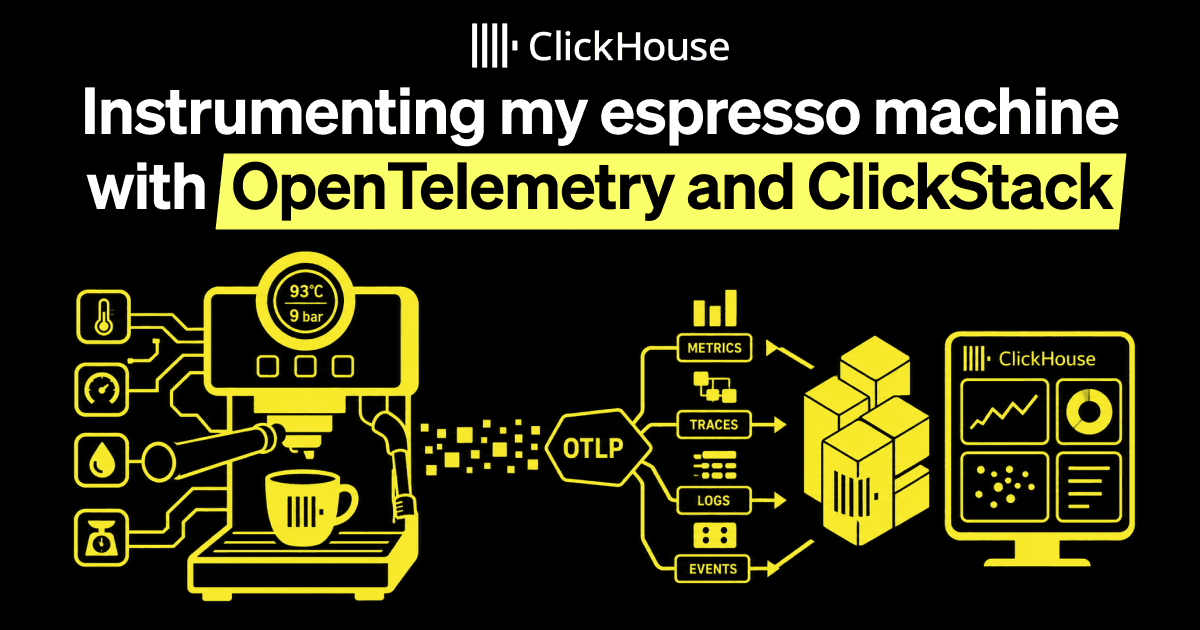
2. Instrumenting my espresso machine with OpenTelemetry (clickhouse.com)

Treating a Gaggia espresso machine like a distributed system: instrumenting an ESP32 with OpenTelemetry, streaming shots and whole-house sensors into ClickHouse Cloud, and putting ClickStack (plus an LLM agent) on top to turn every pull into a queryable,

A Gaggia espresso machine gets a tech upgrade by integrating OpenTelemetry and an ESP32, allowing real-time data streaming to ClickHouse Cloud. This setup not only tracks coffee shots but also connects with whole-house sensors, making it possible to query and analyze the data with an LLM agent.

5. Schmitt Trigger: Robust Comparator Design with Hysteresis (www.wevolver.com)

A Schmitt trigger is a comparator circuit with built-in hysteresis that uses two switching thresholds to eliminate noise and ensure stable output transitions. It is widely used for signal conditioning, waveform shaping, and robust digital and analog circuit design.

Learn how Schmitt triggers enhance circuit stability with their dual threshold design, making them ideal for noise reduction and signal conditioning in both digital and analog applications.

6. GE-97 Terminal: The Old Internet (ge97.com)

A 1997-style personal terminal, home of The Old Internet: boot a working Windows 98 in your browser and surf the 90s web.

Experience a slice of nostalgia with a 1997-style terminal that lets you boot Windows 98 in your browser. Relive the 90s internet and explore the web as it was over two decades ago.

7. Adding Go's Defer to the TypeScript Compiler (healeycodes.com)

Forking tsc to support Go's defer.

A developer is modifying the TypeScript compiler to incorporate Go’s defer feature, which could enhance asynchronous programming in TypeScript. This update might attract interest from those looking to improve their coding efficiency and workflow.

8. I made a Promise-aware debounce and throttle library for TypeScript (github.com)

Promise-aware TypeScript debounce, throttle, batching, retries, concurrency limits, and React/Vue adapters. Zero runtime dependencies. - nyvexis1/temporize

A new library for TypeScript offers promise-aware debounce and throttle functions, along with batching, retries, and concurrency limits, all without any runtime dependencies. It also includes adapters for popular frameworks like React and Vue, making it a versatile tool for developers.

9. Police in the US are making their own true crime podcasts (www.bbc.com)

More police departments are trying to invigorate unsolved murder or missing cases through the power of podcasts.

Police departments across the US are turning to podcasts as a new strategy to engage the public and seek help in solving cold cases of murder and missing persons. This trend highlights how law enforcement is leveraging modern media to connect with communities and generate leads.

12. Designing Icons (m3.material.io)

Material Symbols is a variable icon font with thousands of fonts across seven weights and three styles.

Material Symbols offers a versatile icon font featuring thousands of options in various weights and styles, making it a valuable resource for designers looking to enhance their projects. Discover how this tool can streamline your design process.

14. "Everyone Has Been Sold a Lie" on AI (www.youtube.com)

Following earnings this week that saw tech giants like Microsoft and Amazon report aggressive AI spending plans, EZ Primary Research CEO Ed Zitron gives his ...

17. Show HN: Symbio self fine-tuning AI loop (github.com)

Symbio is an innovative project designed to empower users through seamless interaction with their machines. This flexible system adapts to commands, continually learning and evolving based on user ...

18. Kobuk the Destroyer – Tales from the Wild, Unseen World of Test Engineering (wwnorton.com)

An exuberant exploration of why the stuff we use (mostly) worksβ€”and a celebration of the unsung engineers who ensure it does., Kobuk the Destroyer, And Other Tales from the Wild, Unseen World of Test Engineering, Alex Davies, 9781324051299

Discover the fascinating role of test engineers who guarantee the reliability of everyday technology in β€œKobuk the Destroyer.” This book offers a lively look at the challenges and triumphs of those working behind the scenes to make sure our gadgets function as intended.

19. AI opens new era in cognitive studies of wild primates (news.emory.edu)

Emory anthropologists created an AI system to automate behavioral studies of capuchins monkeys in the wild. The novel method provides a roadmap for the first scalable, systematic way to evaluate and monitor the cognitive abilities of wild primates.

Emory researchers developed an AI system that automates the study of capuchin monkey behavior in their natural habitats. This innovative approach offers a scalable method for assessing the cognitive skills of wild primates, potentially transforming how these animals are understood.

21. The Theater of Sport: Bill Buford Revisits Among the Thugs (www.theparisreview.org)

July 29, 2026 – β€œI kept getting hit by beer cans.”

Bill Buford reflects on his chaotic experiences in the world of sports fandom, highlighting the intense and often violent atmosphere that accompanies live events. His vivid recounting of being pelted with beer cans offers a glimpse into the darker side of sports culture.

23. Show HN: Draco – A single-binary, self-hostable Firecrawl alternative in Rust (github.com)

Contribute to 0xchasercat/draco development by creating an account on GitHub.

Draco offers a lightweight alternative to traditional web scraping tools, eliminating the need for heavy browser instances and costly APIs. With its efficient single-binary design, it quickly converts web pages into clean Markdown or structured JSON, making it easier to gather data without the usual hurdles.

28. Persistent State Machines: LLM Attention with INT4 In-Memory Cells (zenodo.org)

Persistent State Machines: Complete Mathematical Proofs and Vivado Implementation Synthesis (Version 8.0) ABSTRACTΒ We present a formal discrete framework for attention operators in Large Language Models via Persistent State Machines (PSMs). Computation is broadcast to stationary in-memory cells that evaluate local deterministic state transitions. Complete mathematical proofs are given for quantization error bounds, a concrete multi-phase discrete Softmax construction under an explicit bounded-logits assumption, deterministic finite-automaton equivalence with spatial factorization, and membership in DSPACE(O(n)). We validate the implementation feasibility of the architecture on contemporary programmable logic fabric through two distinct evaluation flows: Low-Power Evaluation (Zynq-7000 xc7z020): A full 1024-cell array (d=128) out-of-context (OOC) block design implementation. By annotating the post-route netlist with a Switching Activity Interchange Format (SAIF) file obtained from a post-route functional simulation, we demonstrate that hardware-level self-activation gating restricts active dynamic switching to sparse cells. The dynamic power of the core logic is estimated below 1.0 mW, yielding a normalized dynamic energy of 3.81 Γ— 10^-5 pJ/op. System-on-Chip PCIe Integration (UltraScale+ xcvu9p): To verify system-level compatibility, a 256-cell sub-array (representing an integrated 1-head attention system) is integrated within a full SoC. This includes AMBA AXI4 interconnects and an AMD Xilinx PCIe Gen3 x1 Bridge (XDMA v4.2). The complete SoC successfully closed timing at a unified system clock of 62.5 MHz (Worst Negative Slack WNS = +1.854 ns) under the AWS Cloud FPGA Developer environment. The SoC occupies only 0.67% of the device's logic slices and 0.00% of DSP blocks, showing high scaling potential. Functional simulation with more than one thousand random vectors confirmed bit-exact agreement with a fixed-point software reference. All energy figures are simulation-based tool estimates for the synthesised logic; no physical FPGA board measurement was performed, and system-level external memory energy is strictly excluded. Japanese Patent Application No. 2026-177318 (Patent Pending)

This work introduces a formal framework for attention mechanisms in Large Language Models using Persistent State Machines, detailing how computations can be efficiently executed with in-memory cells. It includes mathematical proofs and a synthesis implementation, making it a valuable read for those interested in the technical foundations of LLM optimization.

Article Details

Browse by Date

Type to search HN and engineering blog articles
Press Escape to close  |  ↑↓ to navigate  |  Enter to open