1. Solid Queue 1.6.0 now supports fiber workers (github.com)

A long-awaited feature thanks to @crmne on this release: instead of using a thread pool to run jobs in multiple threads per works, you can now use fibers on a single fiber reactor thread. To use th...

The latest update of Solid Queue introduces support for fiber workers, allowing jobs to run on a single fiber reactor thread rather than relying on a thread pool. This change promises improved performance and efficiency in job processing.

2. CISA Alert: Water Sector PLC Targeting (censys.com)

CISA alert: Threat actors targeting PLCs in Water and Wastewater Systems. This report includes current Censys-observed internet exposure for each named vendor.

CISA warns that threat actors are targeting Programmable Logic Controllers (PLCs) in water and wastewater systems. The report details the internet exposure of various vendors, highlighting potential vulnerabilities that could be exploited.

3. Glyphs 4 – the leading Mac font editor (glyphsapp.com)

Glyphs 4 is a Mac font editor that puts you in control: quickly draw high-precision vectors, efficiently reuse shapes, and easily manage any number of letters, figures and symbols.

Glyphs 4 offers powerful tools for Mac users to create and manipulate high-precision vector fonts. With features for shape reuse and comprehensive character management, it’s designed for both efficiency and creativity in font design.

5. G'mic 4.0: Squaring the Pixel, Easier (gmic.eu)

A full-featured open-source framework for processing generic image (2D,3D,3D+t) with multiple interfaces: command-line (cli), gimp plug-in, web service, Qt plug-in, C++ library

G’mic 4.0 introduces an open-source framework for versatile image processing, supporting various formats and interfaces, including command-line and plugins for popular software like GIMP. This update makes it easier for users to manipulate images across different platforms and applications.

8. YC founder asks desperate job seekers to tattoo themselves for an interview (sfstandard.com)

LemonLime’s Jordan Zietz said he’s really, really sorry about the whole thing.

Jordan Zietz of LemonLime has stirred controversy by suggesting job seekers tattoo themselves as a bold strategy to stand out in interviews. His public apology adds to the intrigue surrounding this unusual approach to job hunting.

9. A Week in Matrix (piegames.de)

An experience report (read: rant) from an administrator and moderator perspective on how trying to foster an online community in the Matrix ecosystem feels like

An administrator shares their challenges and frustrations in building an online community within the Matrix ecosystem. Their candid account offers insights into the complexities of community management in this decentralized platform.

10. GitHub has alternatives, but no replacement (lalitm.com)

Codeberg, a Git code hosting platform, recently took a decision to prohibit projects that mostly consist of generative-AI-written code which has prompted concern and extensive discussion elsewhere.
The decision does not surprise me, and I don’t mean that as a criticism. Codeberg has always presented itself as a mission-driven alternative to GitHub, not neutral infrastructure.1
What interests me is the disappointment in the response. Many people reacted as though one of the few plausible GitHub replacements had ruled them or their projects out. They wanted Codeberg to be a universal alternative, a better GitHub and the obvious place to go when leaving it.
To me, that exposes a big gap in the open-source space. There are plenty of places to host a Git repository, but remarkably few places to host an open-source community. GitHub gives projects a shared pool of identities, habits and paths to discovery. None of the alternatives has reproduced that at a similar scale.

Codeberg’s recent ban on projects primarily featuring generative-AI-written code has sparked significant debate about its role as an alternative to GitHub. The move highlights the platform’s mission-driven approach and raises questions about the expectations users have for such alternatives.

11. Pgtestdb's template cloning approach to testing is fast (brandur.org)

Postgres database templates make pgtestdb’s per-test database isolation remarkably quick, around 100 ms of setup time, and within spitting distance of River’s schema-based approach.

Pgtestdb leverages Postgres database templates to achieve rapid database isolation for tests, boasting setup times of approximately 100 ms. This method closely competes with River’s schema-based approach, highlighting an efficient solution for developers.

12. Tell HN: I hate your fuzzy search

A user expresses frustration with fuzzy search algorithms across various platforms, advocating for the importance of exact match options. They share their own experience managing a search-heavy site and emphasize the need for better search functionality.

13. BMW Is Showing Commercials on Their Car's Dash Screens as a Treat (www.theautopian.com)

You know what would be terrible? Terrible in a sort of dystopian, capitalism-run-amok sort of way? Imagine buying a brand-new, fancy, premium-grade car. From an automaker with a respected name. Like, say, BMW. This is a machine with some status! Let’s say it costs, oh, $61,500, and you’re paying, what, about $1300 a month? Something […]

BMW’s latest move to display commercials on car dashboard screens raises concerns about the commercialization of personal vehicles. This shift could change the driving experience, turning luxury cars into ad platforms and sparking debates about privacy and consumer expectations.

15. Kaisel – Routes as Values. Dart 3 Native Router for Flutter (kaisel.dev)

A Dart 3-native router for Flutter β€” routes as values. No string paths, no codegen.

Kaisel introduces a new routing system for Flutter that eliminates string paths and code generation, simplifying navigation by treating routes as values. This approach aims to enhance code clarity and maintainability for developers using Dart 3.

18. Study uncovers lost 'golden age' of languages (news.yale.edu)

A new study coauthored by Yale linguist Claire Bowern suggests that tens of thousands of languages were spoken between 1,000 and 3,000 years ago.

A recent study indicates that between 1,000 and 3,000 years ago, there may have been tens of thousands of languages in use, shedding light on a previously overlooked period in linguistic history. This research could reshape our understanding of language development and diversity.

21. Google kills Earth AI generator after one day (twitter.com)

Re: our statement on Image Generation in Google Earth:
β€œWe know that people uniquely trust Google Earth for a reliable view of the world. We’ve seen geospatial professionals using this feature for a range of useful purposes, however we’ve also seen people sharing screenshots of

Google has quickly pulled the plug on its AI image generator for Google Earth, citing concerns over trust and misuse. While the tool had potential for professionals, its rapid removal highlights the challenges of balancing innovation with reliability.

22. Oil companies report sky-high profits thanks to wartime crude prices (www.npr.org)

Chevron reported its highest quarterly earnings ever. Shell had its second-biggest quarter, and ExxonMobil doubled its earnings compared with the same time last year.

Chevron, Shell, and ExxonMobil are seeing record profits due to soaring crude oil prices linked to wartime conditions. These financial results highlight the significant impact of global events on the oil industry and investor sentiment.

24. Cookware Got Worse on Purpose: Who Owns Pyrex and All-Clad Now (www.worseonpurpose.com)

One buyout firm quietly collected Pyrex, Corelle, Instant Pot, and Oneida. Farberware is a name on a 200-year lease. And the pans still worth buying.

A buyout firm has acquired several well-known cookware brands, including Pyrex and Instant Pot, raising questions about the quality of their products. Discover which cookware still stands out as a worthwhile purchase amidst these changes.

25. Scanning 7.6 Petabytes of HuggingFace Training Data for Secrets (trufflesecurity.com)

We scanned every public dataset on Hugging Face for live secrets: 7.6 petabytes across 187 million files. We found 221,303 working credentials, including tokens that can push code into software millions of people install.

A comprehensive scan of Hugging Face’s vast public datasets revealed over 221,000 active credentials, including sensitive tokens that could compromise widely-used software. The findings raise significant concerns about data security in machine learning environments.

26. About 100 firefighters are convicted of arson, every year (www.firerescue1.com)

More than 100 firefighters are convicted of arson every year, but a lack of documentation makes it hard to track

Every year, over 100 firefighters face arson convictions, highlighting a troubling trend in the profession. The challenge of tracking these cases stems from insufficient documentation, raising concerns about accountability and public safety.

27. The First Idempotency Key (hatchet.run)

Discovering what we've all copied from Xerox.

The article reveals the origins of the idempotency key concept and how it has been widely adopted across various industries, highlighting its significance in tech history. Learn how a simple idea has been replicated in numerous applications beyond its initial context.

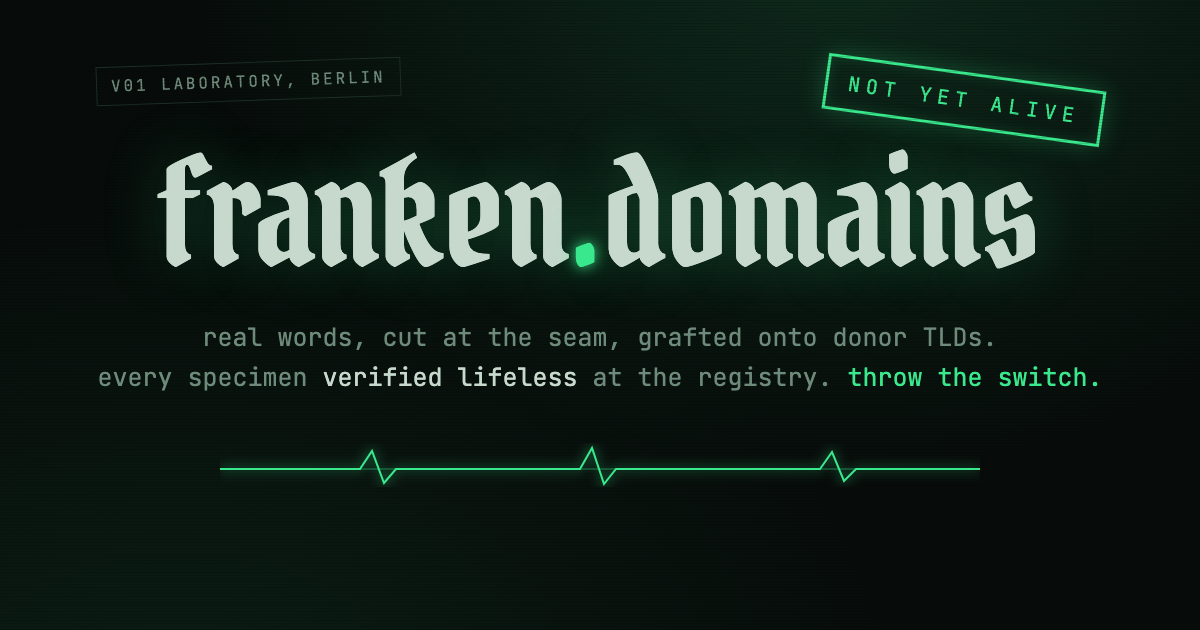
28. Franken.domains: Stitched-Together Domains, Because Every .com Is Taken (franken.domains)

Real words, cut at the seam, grafted onto donor TLDs. Every specimen verified lifeless at the registry. Throw the switch before someone else does.

Franken.domains offers a unique solution for those struggling to find available .com domains by creatively combining words with various top-level domains. This quirky approach could help you snag a memorable web address before someone else does.

29. Astro Loop (pubdeer.com)

Astro Loop: an open-source roguelike shooter for Android. No ads, no tracking, no internet permission. A loop you can

Astro Loop is a unique open-source roguelike shooter for Android that prioritizes user privacy by eliminating ads, tracking, and internet permissions. If you’re looking for a fun and secure gaming experience, this might be worth checking out.

30. Top amputation surgeon had own legs removed due to fetish. Were patients safe? (www.theguardian.com)

Neil Hopper was celebrated for continuing to do his job despite the loss of his lower limbs. But what the people he was treating didn’t know was that his injuries were self-inflicted. Now they and their families are asking questions

Neil Hopper, a renowned surgeon, had his legs amputated due to a personal fetish, raising concerns about the safety of his patients. As families seek answers about his motivations and how it may have affected his medical practice, the implications of his actions come into sharp focus.

Article Details

Browse by Date

Type to search HN and engineering blog articles
Press Escape to close  |  ↑↓ to navigate  |  Enter to open