
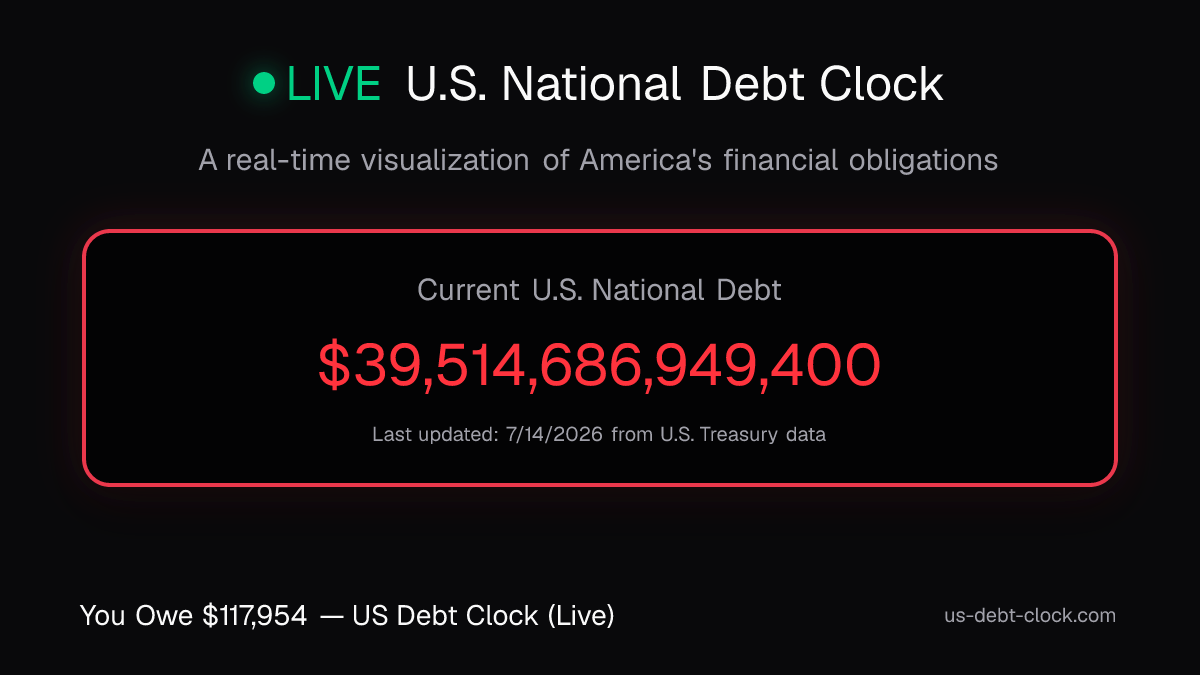
5. US Debt Clock Live (www.us-debt-clock.com)
Track the live US Debt Clock with official Treasury data, current U.S. national debt, debt per citizen, debt per taxpayer, and daily interest costs.

7. Show HN: Tilion – Stealth Browser Infrastructure for Agents (twitter.com)
agents are the next generation of users of the internet, but the web keeps turning them away.
not anymore.
today we're launching tilion, for enabling the next evolution of the web.
sign up for closed beta today.
not anymore.
today we're launching tilion, for enabling the next evolution of the web.
sign up for closed beta today.
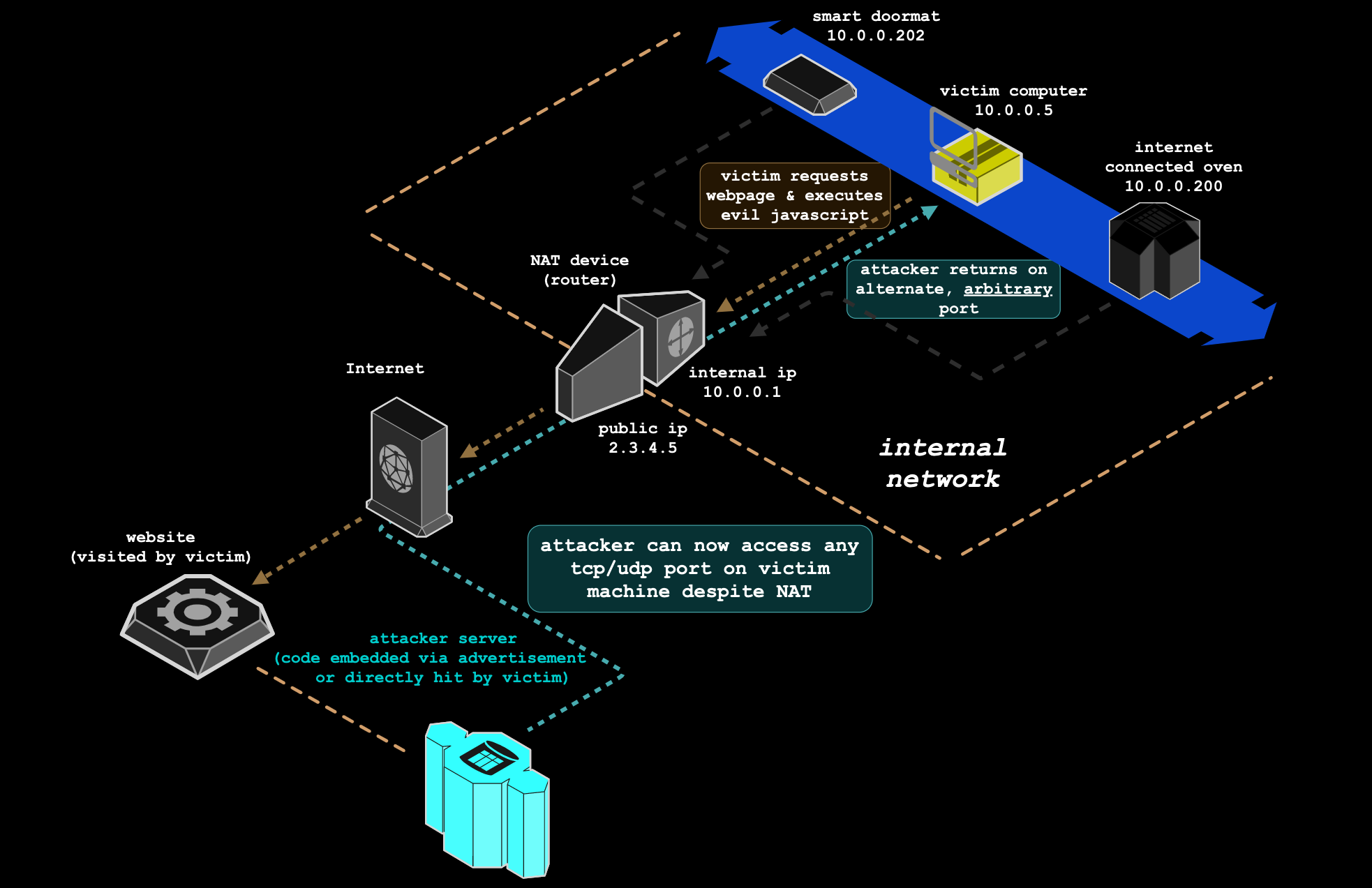
8. Nat Slipstreaming v2.0 allows an attacker to remotely access any TCP/UDP service (sa.my)
exploit NAT/firewalls to access TCP/UDP services bound to any system behind victim
9. Pong Wars on the Commodore 64 (imrannazar.com)
A couple of years ago, I saw a graphics demo in JavaScript that I just had to recreate on the C64. Having never written a real C64 program before, it's been quite a journey, and it's all documented here.

10. Tambara Equipment (bartoszmilewski.com)
I was originally attracted to category theory when trying to understand Haskell optics. I was puzzled by the van Laarhoven’s functor representations and Kmett’s use of Tambara modules. …

11. Show HN: Dropper (dropper.page)
Dropper lives in your Mac's menu bar. Drag files onto it and they upload to your own Cloudflare R2 bucket — a beautiful share page link lands on your clipboard in seconds. Free, no middleman, no subscription.

12. Show HN: Lineation – One security control plane for all agents (lineation.ai)
Cross-provider policy, runtime defense, and forensic lineage for AI agents. Built for security and platform teams who cannot afford blind automation.
13. Show HN: Goku – WASM (wllama)-powered LLM inference and model manager (userfrom1995.github.io)
14. Show HN: PortalJS – AI-native, open-source framework for data portals (github.com)
🌀 AI-native framework for building data portals. Scaffold a full portal from a brief and load datasets in minutes with agentic skills — any backend (CKAN, GitHub, Frictionless). - datopian/portaljs
15. The $110/month self-improving pipeline (andywidjaja.com)
Self-improving software is no longer a funded-startup problem. It


17. Show HN: Chariot – Elastic Claw Compute (www.chariots.sh)
Chariot is elastic claw compute for private AI claws. Bring one or a million up and down on command, with persistent VPS isolation and pay-only-while-working economics.
18. Odin 2 Portal Exploded (github.com)
After using Armada for almost 2 weeks my device has exploded 2 minutes after I unplugged it from a charger. Not sure if it was OS thing and or a faulty battery (although it worked fine on Android f...

19. Show HN: Heard for iOS: ePub reader with on-device text to speech (heard.quest)
An EPUB reader with text to speech for iOS. Listen to classics and your own books with private, on-device narration.
20. Show HN: Running a Website Inside a Website (nonogra.ph)
I stumbled upon a WASM linux terminal emulator that runs inside your browser called linuxontab. I am not affiliated with the site, but I naturally found this ve...

21. Show HN: Greenflash – we read every conversation your AI agent has with users (www.greenflash.ai)
Adapt your AI agents to the real world. See where users get stuck, why agents fail, and what kills retention. Greenflash tests and ships better prompts so your AI improves with every interaction.

22. The age of the Universe from a large sample of the oldest Galactic stars (arxiv.org)
We estimate the age of the Universe using the Xiang & Rix sample of 247,103 Milky Way stars with high-resolution spectroscopy from LAMOST DR7 and $Gaia$ eDR3 parallaxes. Stellar ages were estimated using YY isochrones up to 20 Gyr. To remove stars with unusually high and precise ages, we require old stars to be metal-poor and $α$-enriched. We also require consistency between YY ages and those obtained with FLAME based only on $Gaia$ data. Our final sample of 155,600 stars within 5 kpc provides consistent cosmic age estimates using several techniques of increasing rigour. Our main results use an MCMC reconstruction of the latent age distribution, though our iterative reconstruction is very similar. Applying an innovative approach to our MCMC reconstruction and its uncertainties, we find that the oldest star has an age of $A_\star = 13.73^{+0.18}_{-0.15}$ Gyr. Varying the quality cuts can at most reduce this to $A_\star = 13.31^{+0.21}_{-0.18}$ Gyr or raise it to $14.02^{+0.18}_{-0.15}$ Gyr using a much lower or higher age-dependent metallicity ceiling, respectively. Our inferred $A_\star$ is consistent with the 13.6 Gyr expected in CMB-calibrated $Λ$CDM, assuming the first long-lived stars formed when the Universe was 0.2 Gyr old. This agreement casts doubt on solutions to the Hubble tension solely through new physics prior to recombination, which generally imply a cosmic age of $12.9 \pm 0.2$ Gyr to match low redshift probes. It is difficult for stellar modelling uncertainties to reconcile such a low age with our result given the low metallicities of the oldest stars in our sample and independent asteroseismic constraints.

23. SendLang: A DSL for Email Automation (www.sendlang.com)
SendLang is the home of SendQL and SendFlow: two small languages for defining who you send to and what happens next — text you can diff, review, and hand to a coding agent.
26. Show HN: Asciitopia – a library of animated ASCII art patterns (github.com)
A library of animated, beautiful ASCII patterns for everybody - flawnn/asciitopia
28. Show HN: An incremental build cache for Rust on GHA (github.com)
Registry-backed CI cache volumes: mount on start, push changed chunks on success - clipper-registry/cache
29. Show HN: OpenClaw for Your Health (www.withmurph.ai)
Murph figures out what works for you—and gets your friends in on it. A personal health AI that runs experiments with you and challenges with your friends.