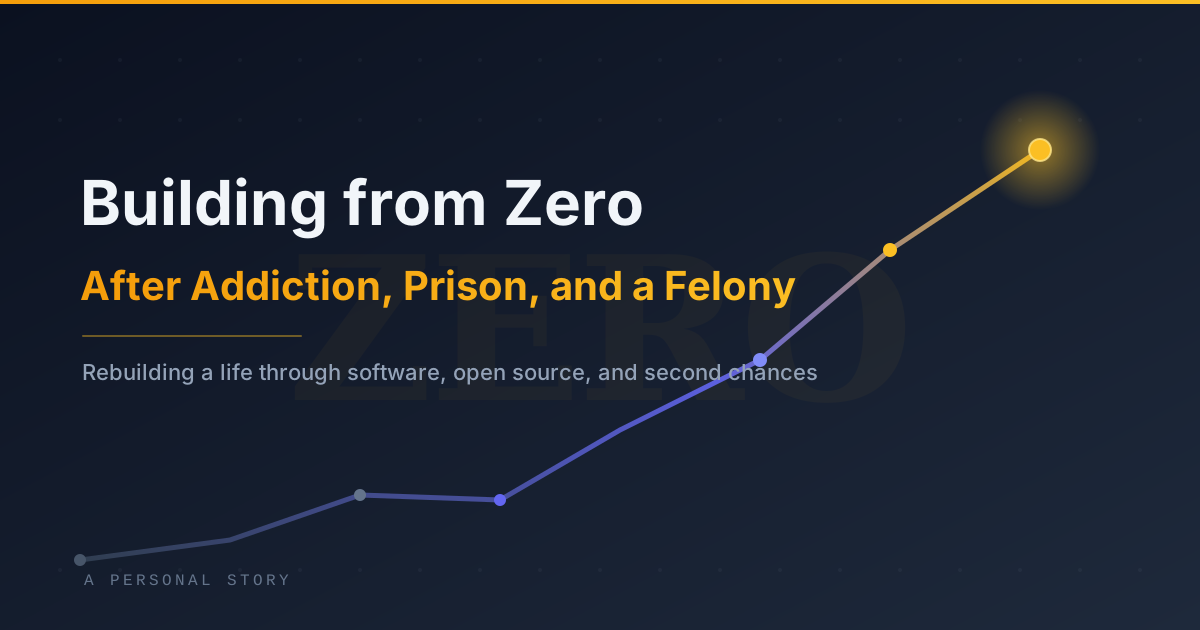
2. Building from Zero After Addiction, Prison, and a Felony (gavinray97.github.io)

I spent ages 14-16 in a maximum-security juvenile prison, became a felon at 19, lost almost everything to addiction, and later rebuilt my life through software, open source, and a few people who took a chance on me. This is the condensed story, written for anyone wondering whether they have a future.

8. Show HN: I Derived a Pancake (www.absurdlyoptimized.com)

The science of perfect pancakes: leavening chemistry, acid-base stoichiometry, whey protein structure, and an interactive calculator that computes optimal ratios from your available ingredients.

9. Making Peace with Your Unlived Dreams (nik.art)

I will never be a great snowboarder. For various genetic and non-genetic reasons, my knees are barely capable of surviving a three-hour hike, let alone the landing after a 1080. In fact, I’ll probably never be a snowboarder at all, given my orthopedist told me to stay away from anything that’s heavy on the knees, […]

13. Public Domain Image Archive (pdimagearchive.org)

Explore our hand-picked collection of out-of-copyright works, free for all to browse, download, and reuse. This is a living database with new images added every week.

19. Tokenomics: Quantifying Where Tokens Are Used in Agentic Software Engineering (arxiv.org)

LLM-based Multi-Agent (LLM-MA) systems are increasingly applied to automate complex software engineering tasks such as requirements engineering, code generation, and testing. However, their operational efficiency and resource consumption remain poorly understood, hindering practical adoption due to unpredictable costs and environmental impact. To address this, we conduct an analysis of token consumption patterns in an LLM-MA system within the Software Development Life Cycle (SDLC), aiming to understand where tokens are consumed across distinct software engineering activities. We analyze execution traces from 30 software development tasks performed by the ChatDev framework using a GPT-5 reasoning model, mapping its internal phases to distinct development stages (Design, Coding, Code Completion, Code Review, Testing, and Documentation) to create a standardized evaluation framework. We then quantify and compare token distribution (input, output, reasoning) across these stages.
Our preliminary findings show that the iterative Code Review stage accounts for the majority of token consumption for an average of 59.4% of tokens. Furthermore, we observe that input tokens consistently constitute the largest share of consumption for an average of 53.9%, providing empirical evidence for potentially significant inefficiencies in agentic collaboration. Our results suggest that the primary cost of agentic software engineering lies not in initial code generation but in automated refinement and verification. Our novel methodology can help practitioners predict expenses and optimize workflows, and it directs future research toward developing more token-efficient agent collaboration protocols.

30. The OnlyFans Economy of American AI (leoveanu.com)

β€œThe dreamers look skyward with longing. The Internet hums with its usual promise β€” you will find your people, your myth, your wonder, and maybe your transformation.”

Article Details

Browse by Date

Type to search HN and engineering blog articles
Press Escape to close  |  ↑↓ to navigate  |  Enter to open