Sorry Peter. — I'm at a birthday party, and while most people here also work in tech, there's always a Guy with a Real Job. You know, a physical job, building some or other thing people need. And this Guy always asks some variant of the same question: aren't you worried AI is taking your job? I glance around and see a few faces turning around toward us, rolling their eyes ever so slightly before returning to their previous conversation. Yes, this question again.
Original article: PIX: el sistema de pago brasileño presionado por Visa y Mastercard Brazil's Pix Payment System Faces Pressure from Visa and MastercardIn
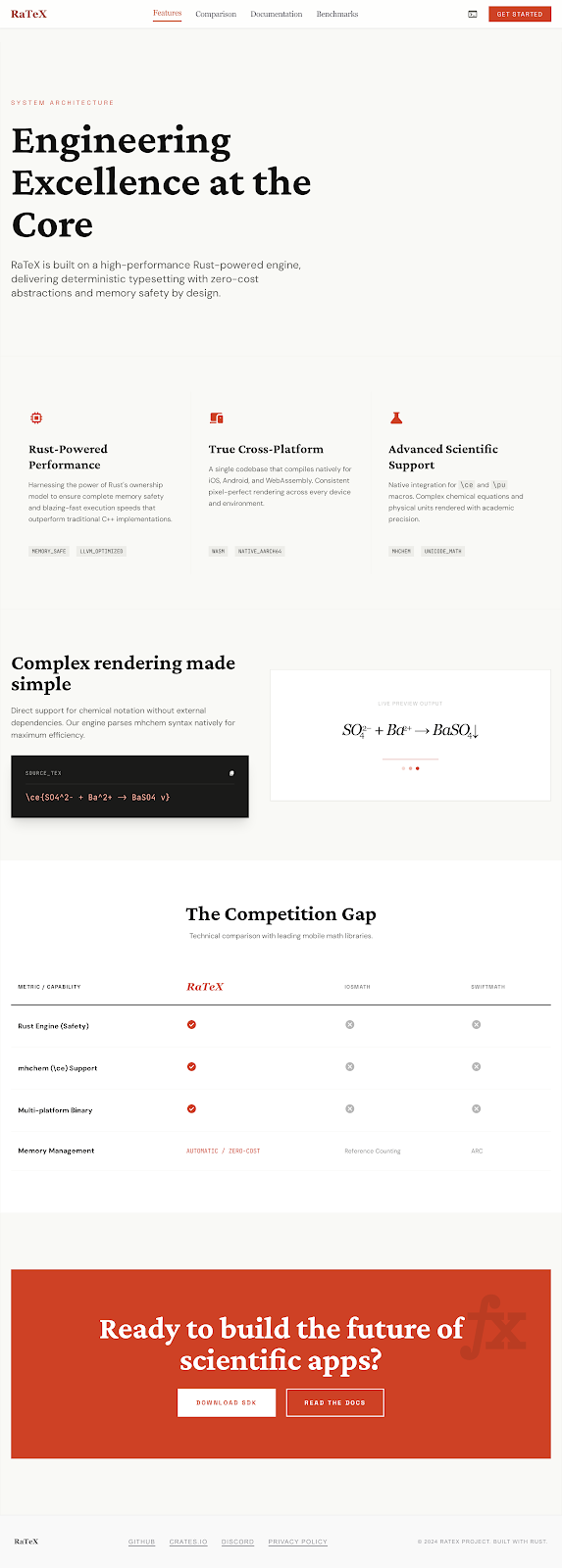
Rust TeX-style math layout with KaTeX-aligned golden tests. Ready-to-use packages for Web (WASM), iOS, Android, Flutter, and React Native—same display list everywhere.
Upgrade your project car to electric with Chevrolet's eCrate system, featuring a 400V motor and 66 kWh battery for superior performance and reliability.
Turning ideas into full software projects from scratch has become a popular use case for language models. Agents are being deployed to seed, maintain, and grow codebases over extended periods with minimal human oversight. Such settings require models to make high-level software architecture decisions. However, existing benchmarks measure focused, limited tasks such as fixing a single bug or developing a single, specified feature. We therefore introduce ProgramBench to measure the ability of software engineering agents to develop software holisitically. In ProgramBench, given only a program and its documentation, agents must architect and implement a codebase that matches the reference executable's behavior. End-to-end behavioral tests are generated via agent-driven fuzzing, enabling evaluation without prescribing implementation structure. Our 200 tasks range from compact CLI tools to widely used software such as FFmpeg, SQLite, and the PHP interpreter. We evaluate 9 LMs and find that none fully resolve any task, with the best model passing 95\% of tests on only 3\% of tasks. Models favor monolithic, single-file implementations that diverge sharply from human-written code.