
A page looks innocent: the algorithms behind a typeset page
When you look at a page of a well-typeset book or catalog, you usually don't notice anything special. There is some text, maybe a table, a picture or a footnote. But every line on such a page is the result of many small decisions. The algorithms behind them were invented decades ago, and people still work on them today.
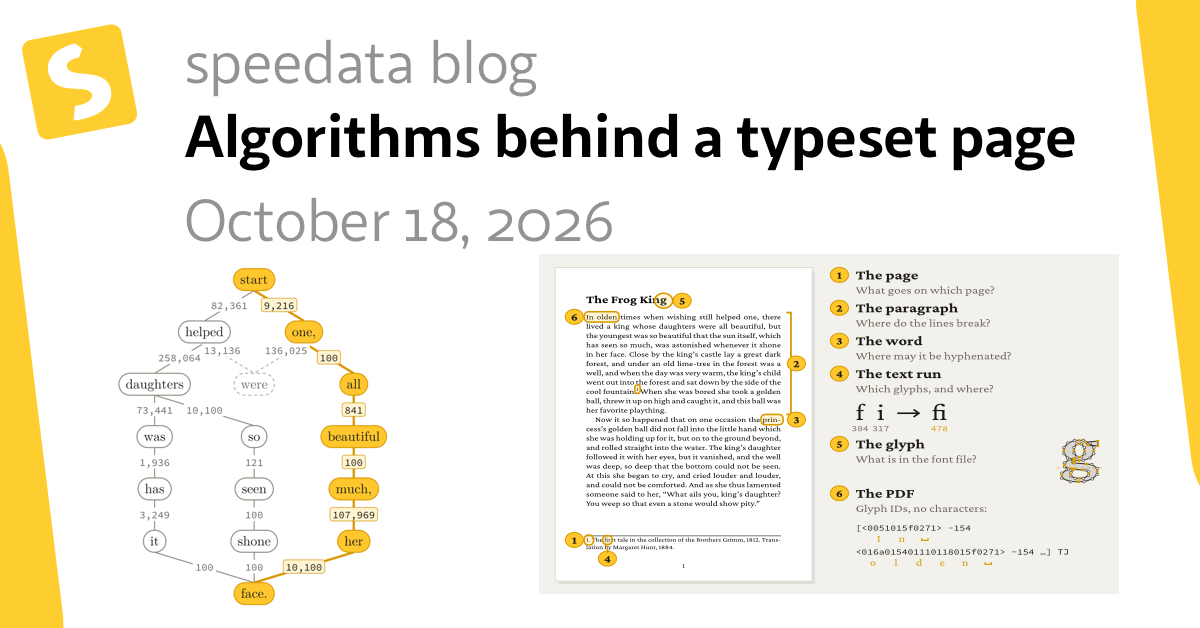
In this post I want to show what happens on a page. I start with the whole page and then go down step by step, until we are at the bytes in the PDF file. On each level I show how the speedata Publisher does it (it uses LuaTeX in the background) and how boxes and glue does it. boxes and glue is the Go library I am writing as a foundation for the future. Both are open source, you find them on GitHub: speedata/publisher and boxesandglue.
In this post I want to show what happens on a page. I start with the whole page and then go down step by step, until we are at the bytes in the PDF file. On each level I show how the speedata Publisher does it (it uses LuaTeX in the background) and how boxes and glue does it. boxes and glue is the Go library I am writing as a foundation for the future. Both are open source, you find them on GitHub: speedata/publisher and boxesandglue.
Summary
Every element on a well-typeset page stems from intricate algorithms that have evolved over decades. This article breaks down the process from the overall layout to the individual bytes in a PDF, revealing the hidden complexity behind seemingly simple pages.
Comments (1 of ) ⌛