
Worst-case glacial lake flood scenarios in a transboundary Himalayan basin 2022
Abstract. Glacial lake outburst floods (GLOFs) are a major concern throughout High Mountain Asia, where societal impacts can extend far downstream. This is
particularly true for transboundary Himalayan basins, where risks are expected to further increase as new lakes develop. Given the need for
anticipatory approaches to disaster risk reduction, this study aims to demonstrate how the threat from a future lake can be feasibly assessed
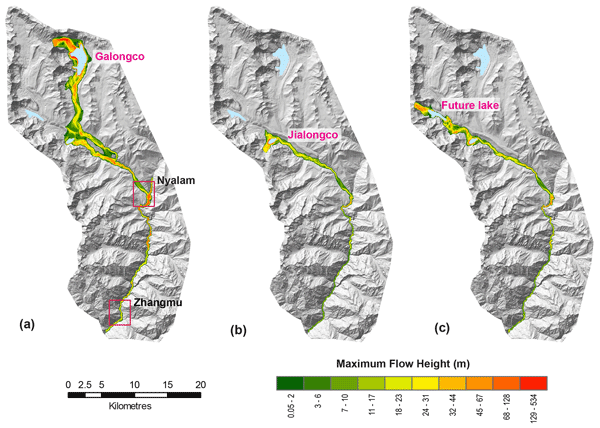
alongside that of worst-case scenarios from current lakes, as well as how this information is relevant for disaster risk management. We have focused on two previously identified dangerous lakes (Galongco and Jialongco), comparing the timing and magnitude of simulated worst-case outburst events from these lakes both in the Tibetan town of Nyalam and downstream at the border with Nepal. In addition, a future scenario has been assessed, whereby an avalanche-triggered GLOF was simulated for a potential large new lake forming upstream of Nyalam. Results show that large (>20×106 m3) rock and/or ice avalanches could generate GLOF discharges at the border with Nepal that are more than 15 times larger than what has been observed previously or anticipated based on more gradual breach simulations. For all assessed lakes, warning times in Nyalam would be only 5–11 min and 30 min at the border. Recent remedial measures undertaken to lower the water level at Jialongco would have little influence on downstream impacts resulting from a very large-magnitude GLOF, particularly in Nyalam where there has been significant development of infrastructure directly within the high-intensity flood zone. Based on these findings, a comprehensive approach to disaster risk management is called for, combining early warning systems with effective land use zoning and programmes to build local response capacities. Such approaches would address the current drivers of GLOF risk in the basin while remaining robust in the face of worst-case, catastrophic outburst events that become more likely under a warming climate.
Summary
This study evaluates the risks of glacial lake outburst floods in transboundary Himalayan basins, highlighting how new lake formations could exacerbate existing threats. It proposes methods for assessing potential future flood scenarios to improve disaster risk management strategies in the region.
Comments (209 of ) ⌛